

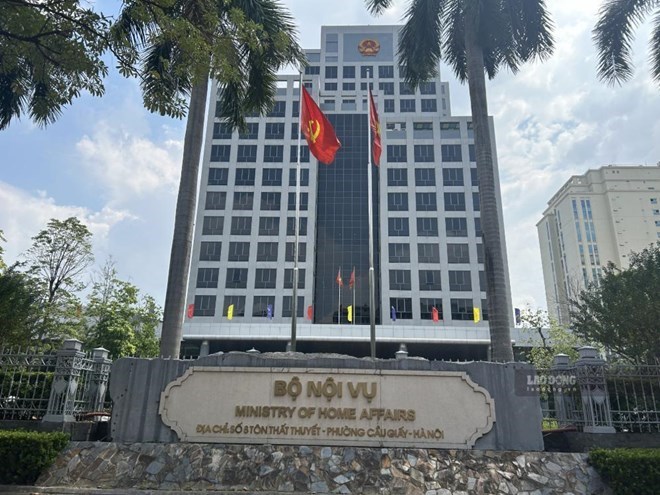
Key tasks related to the organizational structure within ministries and sectors
The key task set out by the Ministry of Home Affairs in the fourth quarter of 2026 is to continue to review and streamline the organizational structure within ministries and sectors.
In the past 9 months, the Ministry of Home Affairs has proactively advised on perfecting institutions to meet the requirements of arranging and streamlining the organizational structure. Notably, it submitted to the Government for promulgation Decree No. 121/2026/ND-CP dated April 3, 2026 on the establishment, reorganization, and dissolution of administrative organizations and Decree No. 299/2026/ND-CP dated July 28, 2026 on the organization of public non-business units.
These are important documents creating a legal basis to continue reviewing the functions, tasks, organizational structure and innovating the operating methods of administrative agencies and public non-business units.
The Ministry of Home Affairs focuses on appraising and guiding the development of functions, tasks, powers and organizational structure of ministries and ministerial-level agencies.
A noteworthy point is that the arrangement process has created specific changes in the number of focal points. According to the report, ministries and ministerial-level agencies have reduced 40/142 departments under departments, equivalent to a decrease of 28.2%; and at the same time reduced 55/678 public non-business units inside compared to September 30, 2025, equivalent to a decrease of 8.1%; gradually streamlining intermediate focal points and reducing organizational levels in the apparatus.
A major content in the organizational structure for the first 9 months of 2026 is to continue to arrange public non-business units, especially in the fields of education and health. The total number of public educational institutions decreased from 37,530 to 18,548, or a decrease of 18,982 focal points, equivalent to a decrease of 50.6%.
The reorganization of the local government apparatus is being implemented simultaneously in both aspects: rearranging organizational focal points and redefining tasks and powers.
The Ministry of Home Affairs has guided ministries, branches, and localities to continue to arrange and streamline focal points, and promote autonomy.
At the same time, the Ministry also provides guidance on the authority to establish, reorganize, dissolve, functions, tasks, organizational structure, job positions and the number of employees for public non-business units providing basic and essential multi-sectoral and multi-field public non-business services under commune-level People's Committees.
The Ministry continues to coordinate in reviewing and arranging educational institutions and medical facilities in accordance with the new organizational model.
Regarding the arrangement of public educational institutions in localities, it continues to be implemented according to the direction of the Government and the Prime Minister.
The Ministry of Home Affairs has issued documents guiding the policy settlement for leadership and management personnel of educational institutions affected by the arrangement.
As of August 24, 34/34 localities have approved rearrangement projects, of which 16 localities have completed; the total number of public educational institutions is expected to decrease from 37,530 to 18,548, a decrease of 18,982 focal points, equivalent to 50.6%.
At the conference to deploy tasks for October and the fourth quarter held on October 9, Chief of Office of the Ministry of Home Affairs Bui Huy Tung informed that in the fourth quarter, the Ministry of Home Affairs will continue to implement Conclusion No. 76-KL/TW, Plan No. 06-KH/TW and Resolution No. 221/NQ-CP on completing the organizational model of the political system and local government at 2 levels; completing the project of community self-management model after arrangement; project of forming commune-level administrative units with core characteristics.
A key task set out is to continue to review and streamline organizations inside ministries and sectors; review, decentralize, delegate powers, and delimit authority for local authorities, especially at the commune level.
Read the original here
- It is not possible to just rearrange the apparatus and keep the working method that is no longer suitable
- The 2nd session of the 16th National Assembly considers many draft laws that directly affect the organizational structure
- The Secretariat established a delegation to comprehensively supervise and evaluate textbooks, apparatus, and personnel