


The measure of success of the law is to facilitate and reduce costs for society
According to General Secretary and President To Lam, the measure of success of the law is to create favorable conditions and reduce costs for society.
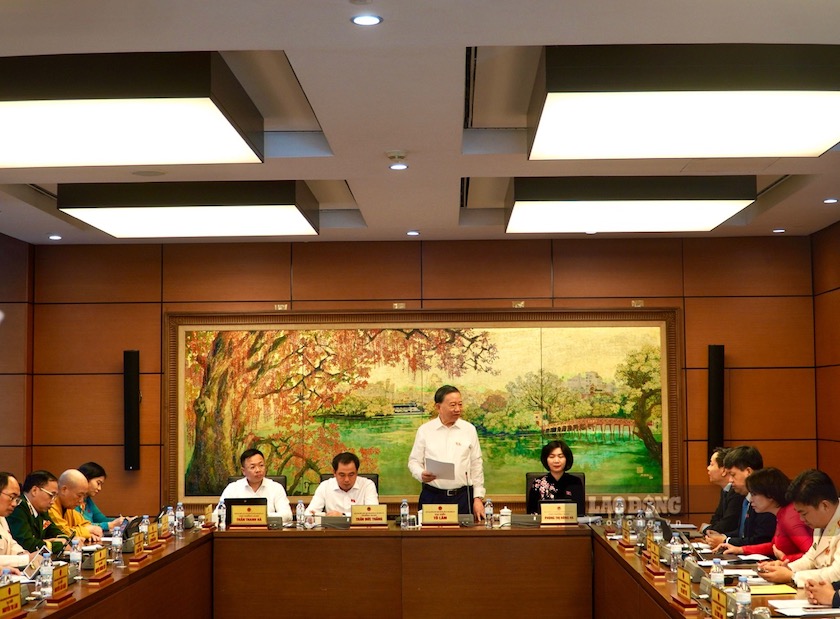
On the morning of October 17, the National Assembly discussed in groups the draft Law on Posts (amended) and the draft Law amending and supplementing a number of articles of the Law on Measurement.
Mismeasurements can affect people's rights
Speaking at the group, General Secretary and President To Lam emphasized that the amendment of these 2 laws needs to be carefully and comprehensively studied to suit the requirements of economic development.
Regarding the field of measurement, the General Secretary and President said that the measurement results are not only related to daily transactions such as electricity and water bills, product quality, but also affect production, health, environment and the determination of violations of the law. Deviations in measurement can cause damage to people, cause businesses to lose markets, and even affect important decisions related to health, life and legal liability.
From that reality, the General Secretary and President proposed to complete the draft Law on Measurement in 4 directions.
First, develop measurement capacity to improve the autonomy of the economy. To master technology, it is necessary to have the ability to measure and verify product quality. If measurement capacity does not keep up, research activities are difficult to transform into production, and businesses are also difficult to participate deeply in the value chain.
With an estimated budget of about 9,000 billion VND for the 2026-2030 period for the system of standards, measurement and consolidation of digital platforms, General Secretary and President To Lam proposed to clarify the order of priority, common use capacity and output results.
Investment efficiency needs to be assessed by internationally recognized measurement capacity, service capacity for businesses and service cost reduction" - General Secretary, President To Lam emphasized.
Second, reducing pre-inspection must go hand in hand with grounded post-inspection and clearly define responsibilities. The enterprise's self-declaration of capacity needs to be simple and public, not turned into a procedure for approval. Inspection activities must be based on risks, avoiding multiple inspections for units that comply well but fail to detect fraudulent acts in time.
Third, digital transformation must improve the reliability of measurement results and reduce costs. Existing data needs to be reused, avoiding requiring businesses to report the same information to multiple agencies, while ensuring business secrets and information security.
Fourth, it is necessary to protect the rights of people when errors and measurement fraud occur.
The General Secretary and President cited specific cases, when detecting fraudulent electricity and water meters or gasoline and oil meters, it is necessary to determine the time, scope of impact, amount of wrongly collected money and responsibility for reimbursement and compensation. It is not possible to only punish violations but leave the rights of the victims open.
The Postal Law needs to keep up with e-commerce
Regarding the draft Postal Law, General Secretary and President To Lam said that the scope of regulation needs to accurately reflect the reality of development.
Postal activities are currently not only limited to traditional delivery services but also associated with e-commerce, logistics, transportation, cross-border delivery and new technologies such as unmanned aerial vehicles (UAVs).
Therefore, it is necessary to clarify the boundaries between post, transportation, logistics and e-commerce, and at the same time define responsibilities between management agencies to avoid overlap, causing businesses to meet many layers of conditions for the same operation.
In addition, the law needs to ensure that essential services reach all people, along with the effective use of state resources.
One mail can go through many units, many stages, but people cannot have to find each side themselves to determine responsibility when goods are lost or damaged.
According to General Secretary and President To Lam, the completion of the two draft laws must be linked to the conditions for implementation, resources and specific responsibilities. The application of new technology needs to help goods circulate more conveniently, reduce business costs, improve service quality and ensure that people in all regions are served better.
The measure of success is that goods circulate more conveniently, businesses reduce costs, people in all regions are served better, rights are guaranteed more firmly, and prices must become cheaper and cheaper" - General Secretary and President To Lam directed.
Read the original here