

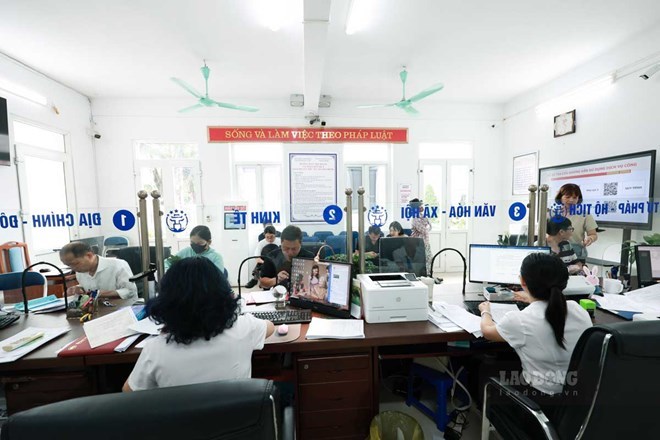
Politburo outlines 5 principles in determining job positions
The Politburo clearly stated that it does not take the current number of personnel, ranks, grades or assigned staff quotas as a direct basis for determining job positions.
This content is stated in Conclusion No. 107-KL/TW dated October 17, 2026 on completing the system of job positions in the political system associated with building a contingent of cadres and managing staff.
In Conclusion No. 107-KL/TW, the Politburo stated 5 principles in determining job positions, which are:
(1) Determined on the basis of the functions, tasks, and authority of agencies, organizations, and units; associated with the content of work, products, results, responsibilities and capacity requirements, and at the same time taking into account the impact of decentralization, delegation of power, application of science and technology, digital transformation, autonomy and socialization. Do not take the current number of personnel, ranks, grades or assigned staff quotas as a direct basis for determining job positions.
(2) Each position is associated with a relatively stable work group, with clear products and responsibilities; no separate job positions are formed just because of unexpected stages, tasks or differences in ranks and grades. Integrate job positions with similar characteristics and use common human resources when appropriate.
(3) Unify the basic description of tasks, products, authority, coordination relations and capacity requirements; suitable to the specific characteristics of Party, State, Fatherland Front, socio-political organizations and each specialized field.
(4) Clearly define the tasks of presiding, coordinating and responsibility between agencies and levels; thoroughly overcome the situation of overlap, duplication, omissions, and duplication; link decentralization with implementation capacity, strengthen inspection, supervision, and post-inspection.
(5) Review and adjust when functions, tasks, authority, organizational model, and working methods change; inherit content that is still appropriate, without requiring the re-establishment of the entire dossier.
Read the original here