
Female workers bear double pressure in the digital age
The pressure of digitized work and family responsibilities make many female workers overloaded, posing a requirement to innovate the care activities of the Trade Union organization.
Work pressure and family responsibilities
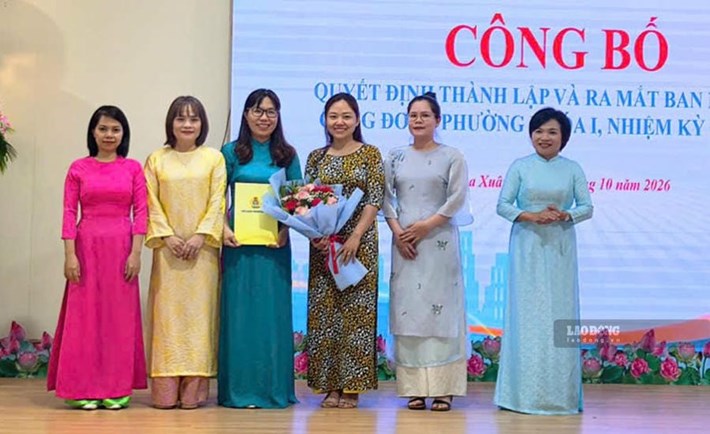
Hoa Xuan Ward Trade Union, Da Nang City, has just organized a summary of 15 years of implementing Resolution 6b/NQ-BCH on mobilizing female workers, civil servants, and laborers in the period of accelerating industrialization and modernization of the country and Directive 03/CT-TLĐ on continuing to promote the emulation movement "Good at work, good at home" among female workers, civil servants, and laborers (2010-2025).
On this occasion, Ms. Nguyen Thi Do - Chairwoman of Hoa Xuan Ward Trade Union, raised a noteworthy reality about female workers. That is the responsibility of taking care of the family and the pressure of work in the digital age are making many female workers easily fall into a state of overload, affecting both physical and mental health.
According to Ms. Do, Hoa Xuan Ward Trade Union currently has 3,441 female union members and is increasingly deeply involved in production, business, and service activities, focusing on fields such as health, education, accounting, administration, human resource management, garment and technology-related service industries.
However, the development of technology also brings new pressures. If in the past, work mostly ended when workers left their offices and factories, now smartphones, emails and online work platforms make the line between working hours and rest increasingly difficult to define. Many female workers after a working day still have to continue processing information, replying to messages, and completing arising tasks. Meanwhile, the responsibility of taking care of children, housework, and caring for loved ones is still mainly placed on their shoulders in many families.
Deploying many care solutions
According to Ms. Nguyen Thi Do, through summarizing 15 years of implementing Resolution 6b/NQ-BCH on mobilizing female workers, civil servants, and laborers and Directive 03/CT-TLĐ on the emulation movement "Good at work, good at home", the Ward Trade Union identified two major challenges for female workers. These are pressure from family and work responsibilities in the digital age, along with the unstable income situation of a part of female workers in the face of fluctuations in the labor market.
Over the past time, grassroots trade unions in the area have implemented many activities to care for female workers such as propagating policies and laws, organizing forums on family, gender equality, health care and child education.
The movements "Good at state affairs, good at housework", "Women actively study, creatively work, build happy families" continue to be maintained. Notably, many grassroots trade unions have mobilized men to share the responsibility of taking care of children, the elderly and family work, contributing to changing perceptions about gender equality.
However, in the new context, taking care of female workers cannot just stop at activities of visiting, giving gifts on holidays, Tet or supporting when encountering difficulties. What female workers need is also a suitable working environment, reasonable rest time, learning opportunities to improve skills and sharing responsibility from family.
In particular, as technology is increasingly deeply present in work, businesses need to pay attention to allocating workload, limiting the requirement to handle unnecessary overtime tasks, creating conditions for workers to balance work and life. The Trade Union organization also needs to further strengthen negotiations on practical policies for female workers, especially those who are pregnant, raising young children or are in difficult circumstances.
See the original here
- Businesses cut bonuses and lower salaries because female workers take maternity leave is a violation of the law
- Representatives care for and protect female workers through dialogues at the workplace
- Businesses call to go to work early while on maternity leave, what should female workers pay attention to?