

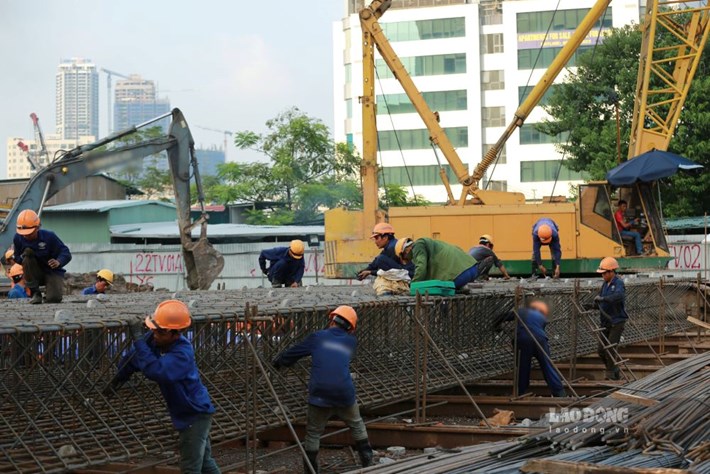
Ensuring occupational safety and health, placing workers in the center
Currently, the requirement to ensure labor safety and hygiene is increasingly urgent, putting people at the center, creating sustainable development for businesses.
The core factor that determines the sustainable development of the business
Identifying ensuring occupational safety and health (ATVSLĐ) as one of the core factors, deciding the sustainable development of enterprises, many enterprises have focused on training and improving skills for workers (NLĐ) and investing in building a safe working environment.
In the context of accelerating digital transformation and implementing many key projects, the requirement to ensure OSH is increasingly urgent in the spirit of Plan No. 70/KH-TLĐ dated March 4, 2026 of the Vietnam General Confederation of Labor (VGCL) on promoting the building of OSH culture at the workplace.
Regarding the situation of labor accidents in the construction sector in recent years, according to the Department of Employment and Occupational Safety (Hanoi Department of Home Affairs), the construction sector is still one of the industries with many potential risks, especially in the small-scale civil works sector.
It is in this area that the organization of construction, supervision of safety conditions, protection equipment or compliance with technical procedures are often not given due attention.
Local practice clearly shows this. In 2025, Hanoi city recorded 217 labor accidents, of which 135 cases were recorded in labor-related areas, killing 41 people and seriously injuring 43 people. More notably, the informal sector - where workers do not have labor contracts - recorded 82 cases but had 55 deaths and 24 seriously injured people.
According to data released by the Ministry of Home Affairs in August 2026 to amend the Law on OSH, although the frequency of occupational accidents has decreased sharply, many serious occupational accidents still occur.
On average, about 8,000 labor accidents occur annually nationwide, of which about 7,000 are in labor-related areas and about 1,000 are in areas without labor contracts, causing about 9,000 deaths and injuries.
According to the assessment of the Ministry of Home Affairs, the main causes stem from the organization of labor not ensuring safety, working conditions and equipment not meeting requirements; enterprises have not organized adequate occupational safety and health training; while a part of workers still violate labor safety procedures and standards.
Improving the effectiveness of labor accident prevention
2026 is not simply the next year of a cycle, but the starting point of a new development stage, associated with the implementation of the Resolution of the 14th Party Congress. In that context, the requirements for OSH work are also higher and more comprehensive.
National Assembly Deputy Nguyen Van Thang (Delegation of National Assembly Deputies of Hanoi City) emphasized that the amendment of the Law on OSH is not only aimed at creating favorable conditions for state management agencies and businesses, but first of all, it must improve the effectiveness of preventing labor accidents, protecting the lives, health and rights of workers.

The delegate proposed to review the regulations on the rights and responsibilities of grassroots trade unions. The delegate proposed to ensure synchronization between the provisions of the Law on Occupational Safety and Health and the Law on Trade Unions and the current trade union organization model.
In occupational safety and health work, trade union organizations play an important role in representing and protecting workers and detecting unsafe risks right from the grassroots level. However, in places where there are no grassroots trade unions, it is necessary to clearly stipulate mechanisms for upper-level trade unions directly at the grassroots level to receive feedback, recommendations and participate in protecting workers.
Regarding occupational safety and health training, delegate Huynh Quyet Thang (Hanoi National Assembly Delegation) agreed with the policy of shifting from pre-inspection to post-inspection, creating favorable conditions for businesses. However, if post-inspection is not strict, training may become formalistic, workers have certification but lack practical knowledge to ensure safety.
The delegate proposed to immediately stipulate the principles of post-inspection in the law, including publicizing the list of training organizations, periodic and unscheduled inspections, strictly handling violations, and interlinking data of trainees to prevent the issuance of fake certificates.
At the same time, it is necessary to add the act of training that does not ensure quality to the list of prohibited acts; stipulate the content and duration of training suitable to the job position and the level of risk, especially for jobs with strict safety requirements.
See the original here