

Expanding social security policies for female migrant workers
Making a living from heavy work, many female migrant workers in Hanoi are still struggling to take care of their families and raise their children to study in conditions of lack of social security.
Worry about breaking the future of children
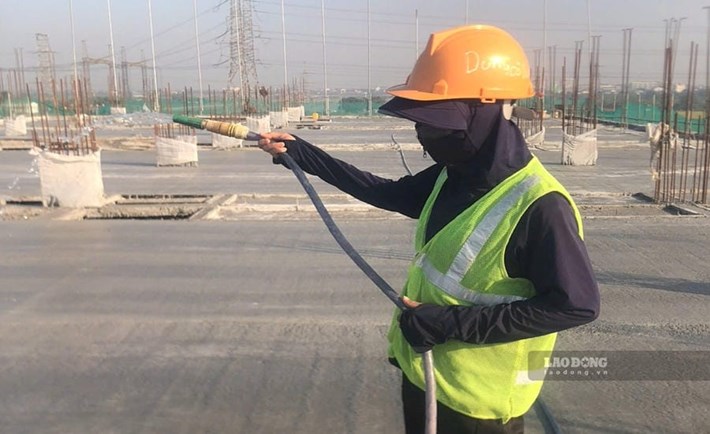
Ms. Nguyen Thi Ha (53 years old, from Hai Hau commune, Ninh Binh) came to Hanoi to earn a living 6 years ago, after her husband passed away. Currently renting a room in Thuong Phuc commune, she works as a construction worker from 7 am to 5 pm, and in the evening continues to clean the house by the hour and help wash dishes at the rice shop.
With an income of 13-14 million VND/month, Ms. Ha has to save money to cover rent, living expenses, raising her son in his second year of university and sending money for medicine to his nearly 80-year-old mother in his hometown. "To avoid falling into the situation of patching things up, I have to save every tens of thousands of VND," Ms. Ha said.
Ms. Ha lives in a shared room with 2 compatriots in a 12m2 rented room, eating frugally to save money. She is most afraid of getting sick, because taking a day off work means losing her daily income. "I am only worried that my child will not get a proper education, the future will be unfinished, and she will suffer like her parents," she shared.
Also leaving her hometown of Bat Xat commune (Lao Cai) to return to Hanoi to work as a hired laborer, Ms. Do Thi Mai (49 years old) is currently a scrap sorting worker at a construction site in Hoang Mai ward (Hanoi). Ms. Mai's daily work starts at 5 am and ends at dusk.
My job is to sort and collect scrap at the construction site, regularly exposed to dust, chemicals and hazardous waste. The wage is calculated according to the volume of collection, averaging 250,000-300,000 VND/day. A full-time month only earns nearly 10 million VND," Ms. Mai said.
Ms. Mai shared that her husband in the countryside is purely engaged in agriculture, income is precarious, all household expenses and worries for 2 children's education depend on the money she sends back.
For the past 2 years, my health has declined, but I still have to stick to the city because there are no other sources of income in my hometown. Without money to send back, my children's studies will be affected. Many times when I am exhausted, I just hope to have a day off or a clean and safe place to recover my health," Ms. Mai shared.
Need to build social security institutions for female migrant workers
According to Ms. Nguyen Thi Lan Huong - former Director of the Institute of Labor Science and Social Affairs, Vietnam currently has about 2.2 million migrant women in the country. The current situation of the lives of female migrant workers in major cities is posing an urgent requirement for the completion of a specific social security system. Most female workers in the informal sector or general labor are burdened with a "double burden": both working hard to earn a living and shouldering the responsibility of taking care of their families, but outside the formal labor protection system.
To reduce pressure and create a support network for this vulnerable labor group, according to Ms. Huong, it is necessary to focus on synchronously deploying three groups of practical solutions.
First, develop safe, standard and cheap boarding house models. Local authorities coordinate with relevant agencies to review and support landlords in renovating infrastructure (minimum area, clean water source, fire prevention and fighting, security and order).
Second, deploy a mobile health network and simplify temporary residence health insurance. Due to concerns about losing working days and costs, female freelancers rarely go for medical examinations. It is necessary to organize free mobile medical examination and treatment and health consultations at boarding houses on weekends; and at the same time create a flexible mechanism for them to easily register and use health insurance at their temporary residence without having to return to their permanent residence in their hometown.
Third, expand small policy credit channels to prevent financial risks. The biggest burden of migrant workers is the obligation to send money back to their hometowns. When families in their hometowns suddenly have sick people, they are very likely to turn to "black credit". Creating conditions for migrant workers to access short-term preferential loans from the Vietnam Bank for Social Policies based on temporary residence confirmation will be a shield to protect them from financial traps, helping them feel secure in their work.
See the original here
- Female workers bear double pressure in the digital age
- Businesses cut bonuses and lower salaries because female workers take maternity leave is a violation of the law
- Representatives care for and protect female workers through dialogues at the workplace
- Businesses call to go to work early while on maternity leave, what should female workers pay attention to?
- Female workers in Da Nang face automation pressure and social security barriers
- Caring for female workers from playgrounds to practical policies
- Maternity benefits for female workers with miscarriage, stillbirth, and abortion
- Not allowing female workers to rest for 30 minutes on their "red light" days, fined up to 40 million VND
- How does the pension of female workers differ when paying social insurance for 20 years or 30 years