
Hanoi approves special mechanism to build 5 metro lines
On November 4, the Hanoi City People's Council passed a resolution piloting specific mechanisms and policies to invest in the construction of urban railway lines in the area. The resolution takes effect for 5 years from the date of signing.
Ensuring financial resources
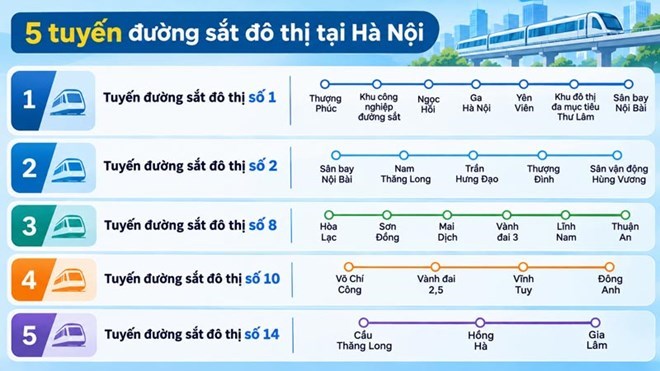
The list of pilot urban railway lines includes: Urban railway line No. 1, No. 2, No. 8, No. 10, No. 14.
Strategic contractors implementing the project must simultaneously meet the criteria: Being approved in principle by the City Party Committee Executive Committee for selection with the aim of completing strategic transport infrastructure, expanding development space, and creating economic development momentum for the Capital.
Along with that, meeting the requirements for valid status according to the provisions of bidding law; the net asset value of the contractor or members of the consortium (in case of a consortium of contractors) in the most recent financial year must not be negative.
Independent contractors or joint ventures must have sufficient financial capacity or prove the ability to mobilize legal capital sources to implement the bidding package. With joint ventures, financial capacity is determined based on the total capacity of members.
In case of participating in the implementation in the form of a hand-to-hand key contract, the contractor must commit to ensuring that the average contract value for underground sections does not exceed 120 million USD/km.
Strict cost control
Reporting at the meeting, Member of the Party Central Committee, Chairman of Hanoi People's Committee Vu Dai Thang said that the city is simultaneously deploying 5 railway lines No. 1, 2, 8, 10 and 14 with a total length of about 253km. These are very large-scale projects, requiring high progress, and the method of organization and implementation needs to be very new. Therefore, there need to be appropriate mechanisms to solve problems related to contract management, capital allocation, meeting payment and organization of implementation.
In the process of drafting the resolution, the City People's Committee directed specialized agencies to study legal regulations, and seek opinions from central state management agencies on finance, budget, investment, construction and contract management.
The Chairman of the City People's Committee said that according to the plan being built, the total capital demand for urban railway projects in the city in the period 2026-2030 is over 1 million billion VND. Of which, the 5 railway lines being implemented alone will require about 900,000 billion VND in this period.
This is a very large investment scale, so right from the time of developing the implementation plan, the city has set out the requirement to strictly control costs, and at the same time proactively build resources to meet the implementation progress" - Mr. Thang emphasized.
For projects under the key-to-key contract method, the city has determined that the average contract price controlled for underground sections does not exceed 120 million USD/km (excluding some costs outside the scope of the contract according to regulations).
This price level is the basis for selecting strategic contractors, establishing total investment and controlling contract value. In the process of implementation, the city will continue to review and control costs based on design, total investment, audit results and contract conditions to ensure not exceeding the controlled price level that has been determined.
Regarding resources, Hanoi City People's Committee is developing a plan to mobilize capital from the city budget, central support, ODA loans, bond issuance and revenue from land funds in urban development areas according to the TOD model.
Talking to a reporter from Lao Dong Newspaper, Assoc. Prof. Dr. Nguyen Hong Thai - Standing Vice Chairman of the Vietnam Railway Transport Economics Association, said that the simultaneous deployment of 5 metro lines marks a shift from investing in each separate line to synchronously developing the entire network.
According to Assoc. Prof. Dr. Nguyen Hong Thai, for special mechanisms to be effective, Hanoi needs to remove institutional obstacles, link decentralization and delegation of power with accountability, quality and cost control; accelerate site clearance, ensure people's rights in compensation, support, and resettlement. At the same time, develop the metro associated with the TOD model, connect public transport modes, promote technology transfer, create conditions for domestic enterprises to participate in designing, manufacturing equipment, construction, and maintenance, towards mastering the railway industry. Assoc. Prof. Dr. Nguyen Hong Thai emphasized that the goal is not only to complete about 253km of urban railway by 2030, but more importantly to form a modern network, operate safely, and create a foundation for sustainable urban development.
With a total investment of nearly 900,000 billion VND, Hanoi not only needs to ensure capital sources but also needs to control progress, quality, operational efficiency, ensure people's rights when site clearance and improve the capacity of domestic enterprises," Assoc. Prof. Dr. Nguyen Hong Thai assessed. Dang Tien
Read the original here