
5 results and 3 key tasks of the 4th Plenum of the 14th Central Committee
On the morning of October 8, at the 4th Conference of the 14th Central Committee, the Central Committee discussed the detailed Outline of the Report summarizing 100 years of the Party leading the Vietnamese revolution (1930 - 2030).
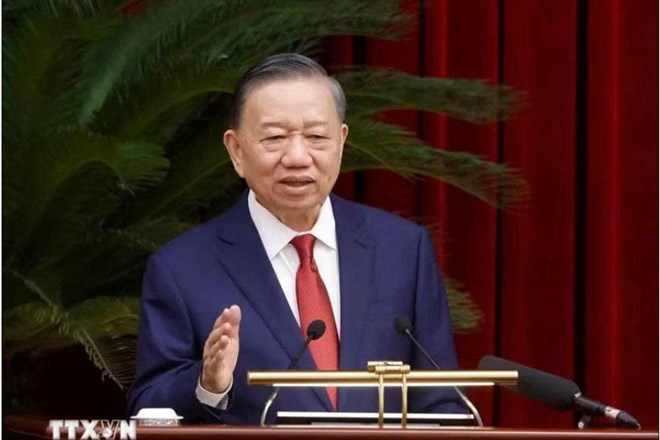
We respectfully publish the full text of the speech of General Secretary and President To Lam at the conference.
* Title set by Lao Dong Newspaper.
Dear Comrades Members of the Politburo, Members of the Secretariat, Members of the Party Central Committee,
Dear comrades delegates attending the Conference,
The fourth Conference of the 14th Party Central Committee completed the program, passed resolutions, regulations, projects, contents under its authority and the Conference Resolution. On behalf of the Politburo and the Secretariat, I respectfully thank you comrades; commend the advisory and service agencies of the Conference.
Continuing the policies from the beginning of the term, this Conference has concretized an important step of the Resolution of the 14th Party Congress, linking Party building with national governance and national development. The policies aim to improve leadership capacity, implementation, and consolidate the strength of the entire nation. The value of the Conference is reflected in the issues being resolved and changes in people's lives. Before closing, I would like to emphasize 05 main results:
First, the Central Committee has agreed on the direction of researching the fundamental issues of the Party and the long-term development path of the country.
The Central Committee approved the outlines summarizing 100 years of the Party leading the Vietnamese revolution, orienting the leadership of national development for the next 100 years; summarizing 40 years of implementing the Platform for building the country in the transitional period to socialism; researching and amending and supplementing the Party Charter. This is the basis for summarizing practice, developing theory and perfecting the Party's organizational foundation.
The Central Committee affirmed its continued attachment to Marxism-Leninism, Ho Chi Minh's ideology, the goal of national independence and socialism; developing theory from Vietnamese practice, selectively absorbing the progressive achievements of humanity. The summary must clarify lessons on choosing guidelines, seizing opportunities, gathering the strength of the entire nation and self-innovation, self-rectification, self-improvement of the Party; explain both success and limitations. The summary must provide a theoretical basis for upcoming policies, identify new issues that need to be researched and resolved. The 2030–2130 vision requires preparing capacity, long-term development conditions, and responsibility for the next generations of the country.
Regarding the Party Charter, the Central Government approved the overall research outline and each group of contents. Research must be linked to summarizing the Platform, maintaining the basic principles and stability of the Charter; distinguishing the inadequacies of the Charter from limitations in regulations on implementation and organization of implementation. Not pre-determining the scope and level of amendment; only proposing truly necessary content, sufficient practical basis and within the scope of the Charter. The authority to amend the Charter belongs to the National Party Congress.
The presiding agencies must deploy on schedule, ensure quality; mobilize the intelligence of theorists, scientists, and practical staff to serve the preparation for the 15th National Congress and strategic decisions of the Party.
Second, the Central Committee has decided on new policies on improving the self-renewal and self-rectification capacity of the Party and the political system.
The Central Committee approved the Resolution on strengthening the building and rectification of the Party and the political system to be clean, strong, and comprehensive, meeting the development requirements of the country in the new era. The Central Committee affirmed the achieved results, pointing out limitations in self-inspection, correcting shortcomings, controlling power and performing responsibilities. Party building must be comprehensive in terms of politics, ideology, ethics, organization and cadres; improving combat strength, exemplary responsibility and awareness of serving the People. Cleanliness and strength must be reflected in the results of work, integrity of cadres and the people's trust.
Building and rectifying the Party must make the Party organization stronger, cadres mature, lead and solve work better. Take building as a basic and long-term task; resolutely prevent and handle violations, prevent degradation, "self-evolution", "self-transformation". To self-correct, first of all, you must hear the truth. Party committees and Party organizations must promote democracy so that cadres and party members speak frankly and responsibly; heads must be receptive and willing to listen to different opinions from themselves. Do not let leniency and avoidance lead to prolonged shortcomings and recurrence of violations; must overcome both violations and loopholes leading to violations. Party committees and heads are responsible for this. Strictly maintain discipline, create an honest environment for cadres to feel secure in solving difficult tasks for the common good. Regularly supervise, warn early, prevent both abuse of power and evasion of responsibility. Power in inspection and supervision must also be tightly controlled.
The Central Committee approved the Regulation on inspection, supervision and discipline of the Party, in accordance with the new organizational model. Party committees and Party organizations at all levels must uniformly and in accordance with their authority and procedures in inspection, supervision, disciplinary action and resolution of disciplinary complaints. Discipline must be strict and fair.
The new Resolution and Regulations must consolidate the attachment between the Party and the People. Party committees must self-check from the people's reflections, protect those who give frank opinions. Listening must go hand in hand with answering and resolving; issues that cannot be accepted must be explained clearly. It is necessary to check the implementation of commitments to the People, consider the inadequacies pointed out to correct the way of doing things and improve policies.
Third, the Central Government determines the requirement to innovate leadership and ruling methods, ensuring the political system operates uniformly and effectively.
The Central Committee approved a new Resolution on innovating the leadership and ruling methods of the Party. Comprehensive leadership must promote the functions and powers of each agency, practically implement the mechanism of Party leadership, State management, and people as masters. It is necessary to improve the quality from problem detection, forecasting, choice of options to decision-making, implementation, inspection and adjustment. Data and technology must help provide accurate advice and early identification of risks. Organizations and individuals with authority are responsible for their decisions.
It is necessary to overcome excuses, do things for others, loosen leadership or ask for many rounds of opinions on matters under authority. State agencies proactively institutionalize, manage, and operate according to the Constitution and laws. Do not interfere to lose the assigned initiative, do not loosen inspection and supervision, do not add layers to handle work. Once authority is assigned, they must decide and be responsible.
The Party's guidelines must be institutionalized into laws and policies in the true spirit, unified and feasible. Responsibility does not stop at issuing documents. The presiding agency must monitor implementation, handle obstacles under its authority, and propose amendments to regulations that are no longer appropriate. When policies do not achieve their goals, it is necessary to consider both the quality of advice, policy design and implementation responsibilities.
Decentralization and delegation of power must be linked to resources, capacity and power control. In the two-level local government model, assigning tasks to the grassroots level must go hand in hand with authority, human resources, and resources. The provincial level must arrange and train cadres, ensuring conditions for the commune level; central agencies must promptly handle obstacles under their responsibility. When work is blocked, it is necessary to consider the responsibility of both the implementing level and the assigned level. Clearly define collective authority, individual responsibility, and strictly adhere to the principle of democratic centralism. Do not use collective responsibility to cover up individual responsibility; individuals do not decide on behalf of collectives.
Innovation in leadership methods must start from the working style of Party committees and leadership agencies. Reduce meetings and duplication of reports; share verified information, spend time for grassroots levels and solve problems. Digital transformation must help smooth work, without generating additional procedures.
Fourth, the Central Government has decided to innovate personnel work and policies to attract and use talents, and prepare a contingent to meet the requirements of national development.
Based on summarizing Resolution No. 26, the Central Government approved a new Resolution on cadres and cadre work; and at the same time approved the Project "National Strategy on attracting, valuing and developing talents in key industries and fields to serve the country's rapid and sustainable development". The country's strategic task is to be the basis for selecting, using, and developing the contingent of cadres.
The Resolution identifies 3 breakthroughs: evaluating, selecting, using and screening cadres; creating sources, developing staff and valuing talents; perfecting institutions and methods of cadre governance. It is necessary to base on task requirements to create sources, train, arrange; use evaluation results to select, screen, and ensure inheritance through terms. Qualities, bravery, real talent, and prestige must be shown through work results; evaluating results must consider the difficulty of tasks, implementation conditions and long-term value. Achievements do not compensate for violations of politics, ethics, and integrity. The person evaluating, introducing, and arranging cadres is responsible for their introduction decisions.
Assign responsibility to those who do well; train and train promising cadres; replace those who do not meet the requirements according to regulations. Strategic-level cadres must know how to forecast, prioritize, gather staff, and handle inter-sectoral and inter-regional issues; grassroots cadres must firmly grasp the area, solve work, and serve the People. Expand resources from the non-state sector and overseas Vietnamese according to standards and task requirements. Prepare a multi-layered successor source; pay attention to young cadres, female cadres, ethnic minorities, scientific and technical cadres; develop a team of leaders, managers and specialized experts. The head is responsible for work, the successor team and organizational capacity. It is necessary to distinguish between intentional wrongdoing, self-interest, irresponsibility with limited capacity and objective risks when innovating for the common good. Protecting cadres must be based on grounds, timely, in parallel with explanation and remedy of consequences; not taking advantage to cover up violations.
The talent strategy places importance on key positions, linking attraction with training, development and dedication. Based on strategic tasks to find people, assign jobs, empower, ensure resources; retain people with a working environment, creative opportunities, and worthy recognition. Emphasizing does not mean appointing leadership and management positions; there must be appropriate forms of use, not necessarily all being in the payroll or working full-time at an agency. Connecting domestic talents, overseas Vietnamese, international experts; linking schools and research institutes with businesses. Taking discovery and training domestic talents as a long-term foundation. Using agencies must assign worthy jobs, create conditions to master technology, build teams, transfer knowledge; recognize and treat fairly between those who are attracted and those who are contributing. Respecting expertise, accepting controlled research risks.
Fifth, the Central Government has agreed on development goals, budget policies and promoted resources to accelerate and break through in 2027.
The Central Committee unanimously assessed: in the first year of implementing the Resolution of the XIV Congress, although the world fluctuated rapidly and complicatedly, the country still achieved important and quite comprehensive results. GDP growth in 9 months was high; major balances were ensured; budget revenue, public investment, FDI, import and export, and tourism increased sharply. Many obstacles in procedures, backlog projects, and infrastructure were removed; digital transformation made progress. Social security was improved; national defense and security were strengthened; foreign affairs was a bright spot of international stature. These results affirm the resilience, adaptability and potential of the economy and the country.
However, the quality of growth and competitiveness of domestic enterprises are still limited; price pressure increases; disbursement and handling of backlog projects are still slow. Resources have been allocated but are slow to be used. Besides external impacts, implementation is still a weak link: some agencies and localities are not proactive, coordination is slow, and grassroots capacity is still limited. Party committees, management agencies, and heads must overcome these limitations. In the last months of the year, ministries, branches, and localities must promptly resolve issues under their authority, report with plans for exceeding authority. Localities, the driving force, locomotive, and growth pole must play a leading role.
The Central Government agreed on the main goals, targets and key tasks for 2027, striving for GDP growth of 10% or more, average CPI growth rate of about 4.5%, maintaining macroeconomic stability, ensuring major balances. 2027 must accelerate, break through, create momentum, create position, create strength for the following years; concretize Conclusion No. 18, associated with innovating the development model according to Resolution No. 19. High growth must be based on productivity, competitiveness, autonomy capacity and a long-term stable foundation; going hand in hand with social progress, social justice, environmental protection and improving all aspects of people's lives.
It is necessary to bring mobilized resources into production and business, creating more jobs and development capacity. Removing institutional bottlenecks is accompanied by improving capital absorption capacity, ensuring infrastructure, energy, and human resources; unblocking private investment, consolidating purchasing power, and developing domestic enterprises. Do not allow waste of capital, land, assets and opportunities. Coordinate fiscal and monetary policies to support growth, control inflation, and risks. Public investment must lead social investment, connect regions, and expand production capacity; disbursement is linked to actual volume and quality. Foreign investment is linked to technology transfer, business linkage, and increasing domestic value. Science, technology, innovation, and digital transformation must improve productivity and competitiveness.
Regarding the budget, the Central Government agreed on the policy of balancing 2027 and dividing revenue sources between the central budget and local budgets; ensuring the leading role of the central budget, the proactiveness of localities, supplementing the accumulated source of salary reform. Nurturing revenue sources, saving from the allocation stage to increase resources for key, urgent projects and social security. Reviewing and proposing adjustments to regulations on the proportion of budget expenditure allocation for industries and fields; not issuing additional regulations. When fluctuations or new policies affect budget revenue, allowing assessment of the completion of financial-budgetary tasks according to the adjusted estimate in accordance with authority. Maintaining strict financial discipline, ensuring long-term balance; evaluating spending efficiency based on actual results, linking allocation responsibility with use.
The Central Committee approved the Regulation on party members participating in investment and business activities, encouraging legitimate enrichment associated with maintaining the nature of the Party, building the Party in the non-state sector and public integrity. Rights, conditions, and limits for participation must be consistent with legal status, responsibilities, and level of risk of conflict of interest. Control must be based on ownership rights, control rights, and actual interests, not just the name holder; protect legitimate economic activities, not allowing power, information, and public assets to become private advantages. Conflicts of interest must be reported and handled within their authority, not stopping at declaration. Party members engaged in economic activities must set an example of law compliance, respect the legitimate rights and interests of workers; create conditions for them to progress and enjoy achievements commensurate with their contributions, contributing to the implementation of social progress and justice, and consolidating the attachment of the people and workers to the Party.
The decisions of the Conference must be implemented synchronously, linking Party building with national development. The results of implementation are the basis for evaluating leadership capacity, personnel work, and responsibilities of each agency and locality. Immediately after the Conference, I propose that you focus on 3 tasks:
First, fully concretize and timely institutionalize the decisions of the Conference. The Politburo and the Secretariat lead and direct; the National Assembly Party Committee, the Government Party Committee and Party committees at all levels implement according to their authority. It is necessary to clearly define the tasks, responsibilities, and conditions for implementation; handle overlapping contents, avoid overlapping and omissions of responsibility. Things that are clear must be done immediately; the pilot must clearly define the scope, authority, time limit, and criteria for assessing and controlling risks.
Second, complete the tasks of 2026 at the highest level, creating a foundation for 2027 to accelerate and break through. Ministries, branches, and localities proactively remove obstacles, prepare plans, budgets, personnel and resources for the coming year. Do not let the difficulties that have been removed and have been determined to be implemented continue to be prolonged due to slow decision-making and evasion of responsibility.
Third, strengthen inspection and supervision of the implementation and promotion of the role of the People. follow key tasks, promptly remove obstacles and rectify shortcomings; inspect the remedy and handling of responsibilities. The Fatherland Front and socio-political organizations strengthen mobilization, supervision, and criticism; ensure that the People participate and enjoy the achievements.
Comrades,
Each Central Committee comrade must directly lead and direct in the assigned field and area; choose the right key tasks, solve to the end the issues under their responsibility. Having received the work to do, having committed to implement it, there are shortcomings and defects that must be overcome and corrected. Exemplary behavior must start from us, from daily work, creating changes in each organization and the whole system. Immediately after the Conference, each Party Committee, each cadre, and each party member should join the people in starting work, removing difficulties, and opening up development opportunities. With bravery, intelligence, and the strength of great national unity, we are determined to successfully implement the Resolution of the 14th National Congress, building a prosperous and happy country, worthy of the people's trust.
I request the Office of the Party Central Committee to coordinate with relevant agencies to soon complete the Conference Documents so that the Politburo - Secretariat can organize a national conference to disseminate, thoroughly grasp and implement the Resolution of the 4th Conference of the 14th Central Committee on October 16, 2026.
With that spirit, I declare the closing of the Fourth Conference of the 14th Central Committee of the Party. Wishing you comrades good health and successful completion of your responsibilities before the Party and the People.
Thank you very much, comrades. /.
Read the original here