

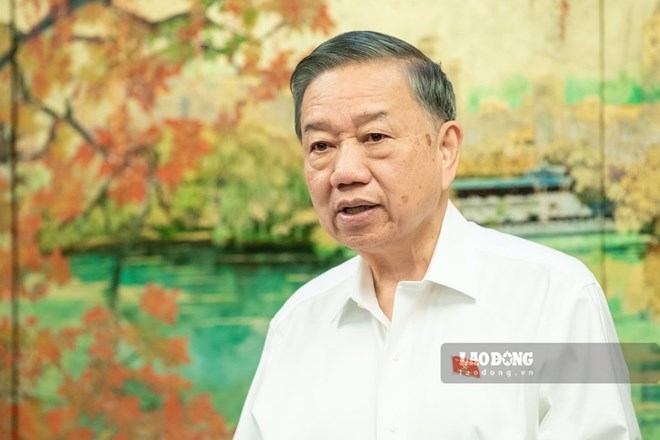
General Secretary and President remind responsibility when abolishing fire prevention and fighting inspection and acceptance procedures
General Secretary and President To Lam emphasized that abolishing the fire prevention and fighting acceptance procedure does not mean loosening the responsibility of investors.
Cutting administrative procedures, not loosening safety management responsibilities
On the morning of October 26, the National Assembly discussed in groups the draft Law amending and supplementing a number of articles of the Law on Management and Use of Weapons, Explosives and Supporting Tools, the Law on Fire Prevention and Fighting (PCCC) and Rescue; The draft Law on Protection of Important Works Related to National Security.
Regarding the draft Law amending and supplementing a number of articles of the Law on Management and Use of Weapons, Explosives and Supporting Tools, the Law on Fire Prevention and Fighting and Rescue, the General Secretary and President expressed agreement with the direction of reducing administrative procedures. However, the requirement is that reform must reduce inconvenience, improve safety control capabilities and these two factors must go hand in hand, and cannot be relaxed or underestimated.
Regarding the direction of removing the fire prevention and fighting acceptance procedure, shifting from pre-inspection to post-inspection, the General Secretary and President emphasized the viewpoint: "Removing the procedure for inspecting the acceptance work of state agencies does not mean removing the acceptance responsibility of investors and owners before putting works and vehicles into use".
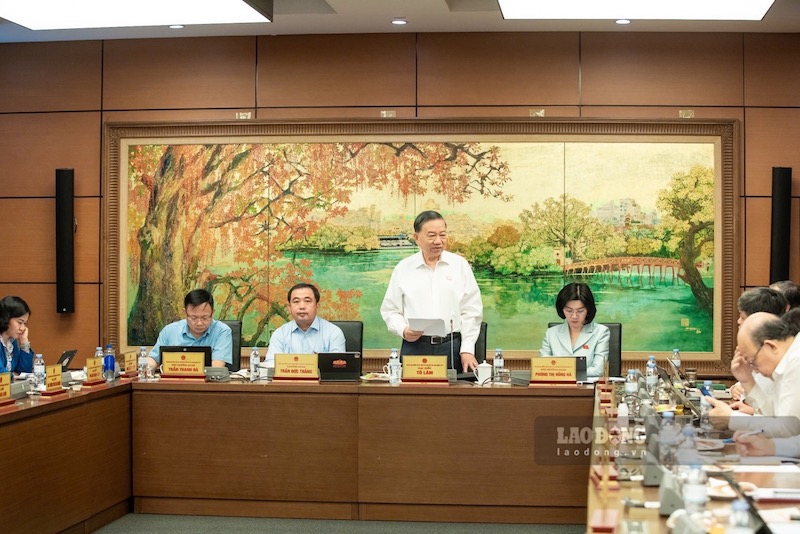
According to the General Secretary and President, the design was appraised correctly but did not ensure that the project was constructed correctly and did not ensure safe operation. Therefore, it is necessary to clearly define the responsibilities of investors, consultants, construction, and supervisors in confirming actual quality, and strictly handle incorrect confirmations and forging dossiers for acceptance. These acts are entirely possible and if they occur, they will leave extremely serious consequences.
Especially when administrative reform, from the initial step, it must be done very seriously" - General Secretary, President stated.
The Head of the Party and State also requested to clarify the responsibilities of investors, consulting units, construction, and supervision in inspecting and confirming fire prevention and fighting quality in practice.
Homebuyers and tenants cannot self-verify the quality of the entire fire prevention and fighting system and must bear the consequences of the investor's violations" - General Secretary and President stated.
The requirement set by Party and State leaders is that when there are violations, risks must be overcome, compensation responsibilities must be determined according to law, and the rights of the victims must be resolved.
The abolition of traffic permits for fire fighting and rescue vehicles, according to the General Secretary and President, must also go hand in hand with quality control, traceability and recall of unsafe products, avoiding the situation where equipment used to save people but due to not being evaluated regularly, when an incident occurs, it cannot be used.
Protecting national security works, ensuring the legitimate rights of the people
Regarding the draft Law on Protection of Important Works Related to National Security, the General Secretary and President said that the paralysis of electricity, data or traffic systems can affect many sectors, localities and people's lives. Therefore, it is necessary to correctly identify the works that need to be protected, the level of protection and the responsibility for proposing. The identification of works that need to be protected must be based on the role for national security, the level of necessity and the consequences if the works stop operating.
The General Secretary and President expressed his agreement with the addition of the requirement to prevent cyber attacks - a new method of infringing. The protection plan must have prevention, rescue, restoration and practical drills. Projects through many localities must clearly define coordination focal points, responsibilities of each locality, and have command mechanisms, etc.
Risks must be detected early, incidents must be prevented promptly, essential activities must be maintained and people must be better protected" - General Secretary and President set requirements for 2 draft amended laws.
Read the original here