

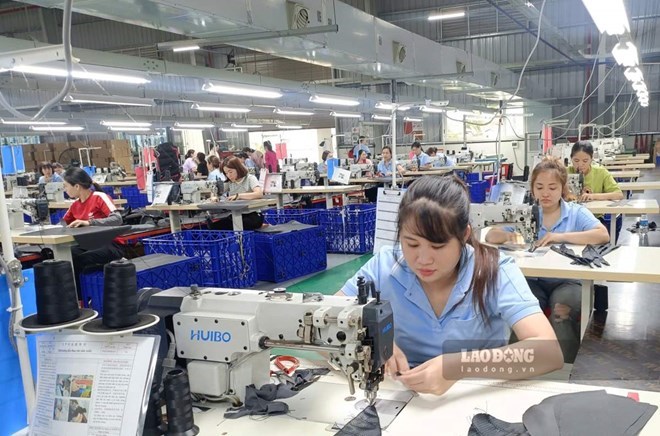
Hai Phong seeks solutions to attract nearly 400,000 workers for FDI enterprises
Hai Phong - In 2026, businesses in industrial parks and economic zones need to recruit more than 120,000 workers. However, the local labor force has not met the demand.
Nearly 400,000 workers needed in the 2026-2030 period
According to a survey by the Hai Phong Economic Zone Management Board, in 2026, businesses in industrial parks and economic zones have a recruitment demand of more than 120,000 workers; in the period 2026 - 2030, the recruitment demand will reach 400,000 workers, mainly concentrated in the electronics, mechanical engineering, supporting industries, textiles, footwear... industries.
Although the demand is very large, the local labor force does not meet the demand, forcing businesses to recruit out-of-province workers and seasonal workers. Currently, out-of-province workers in Hai Phong are about 200,000 people, accounting for more than 21% of the total number of workers at enterprises. At Tong Wei Co., Ltd. (An Duong Industrial Park), out-of-province workers account for 60% of the total number of workers; LG Innotek Co., Ltd. has 6,300 workers, of which 1,500 are out-of-province workers...
At Tohoku Pioneer Vietnam Co., Ltd. (Japan Industrial Park - Hai Phong), the unit currently has 2,300 workers and needs to recruit 1,000 more people due to increased orders. Ms. Nguyen Thi Kim Oanh - Chairwoman of the company's Trade Union said that recruitment is facing many difficulties, so businesses have to temporarily use seasonal workers (students) to meet production requirements.
Similarly, Regina Miracle International Co., Ltd. needs to recruit more than 2,500 workers, LG Innotek Co., Ltd. needs to recruit more than 1,000 workers, Kyowa Co., Ltd. is stable but still needs to recruit about 200 more people...
According to the assessment of the Department of Home Affairs, the labor market is facing a double pressure: both having to attract more labor to meet the needs of expanding production and limiting labor migration due to competition between businesses in terms of wages, benefits, working conditions and career development opportunities.
Creating an environment to retain workers
Faced with the labor shortage situation, the Hai Phong Economic Zone Management Board has worked with businesses with recruitment needs and units operating in the field of labor supply, job introduction and human resource connection.
Accordingly, businesses all believe that, along with the efforts of businesses in improving regimes, wages, benefits, working conditions and career development opportunities, the city needs to promote the development of social housing, rental housing, and dormitories with segments suitable for workers' incomes in industrial parks and economic zones, so that workers can "settle down" and be assured of long-term attachment to businesses and the city.
The city should further promote communication and promote the image of a dynamic and livable city with many development opportunities to attract more out-of-province workers, especially in localities with a large labor force.
On the side of the Trade Union organization, the City Labor Federation also directed grassroots trade unions to actively participate with businesses in solving the problem of recruiting and retaining workers. Trade unions grasp the human resource needs of businesses, thoughts, aspirations, income, working conditions and factors that can cause workers to move jobs.
From early identification of causes of labor fluctuations, the Trade Union participates in dialogue and negotiation with businesses on salaries, benefits, meals, working environment, housing policies and conditions to support workers. From there, helping businesses build recruitment policies to retain workers suitable for each target group.
See the original here