


Abolishing the base salary and salary coefficient when reforming salaries
When salary reform is carried out, the current base salary and salary coefficient will be abolished, and the basic salary level will be built with a specific amount in the new salary scale.
The Ministry of Home Affairs is currently presiding over the development of a project to reform salary and social insurance policies (BHXH). In which, it is expected to complete the project and report to the Government Party Committee in November 2026, before submitting it to the Politburo and the Secretariat in February 2027.
The plan sets a goal to complete the research and development process of the project and draft resolution in an urgent time, as a basis for submitting to the 5th Conference of the 14th Party Central Committee for consideration.
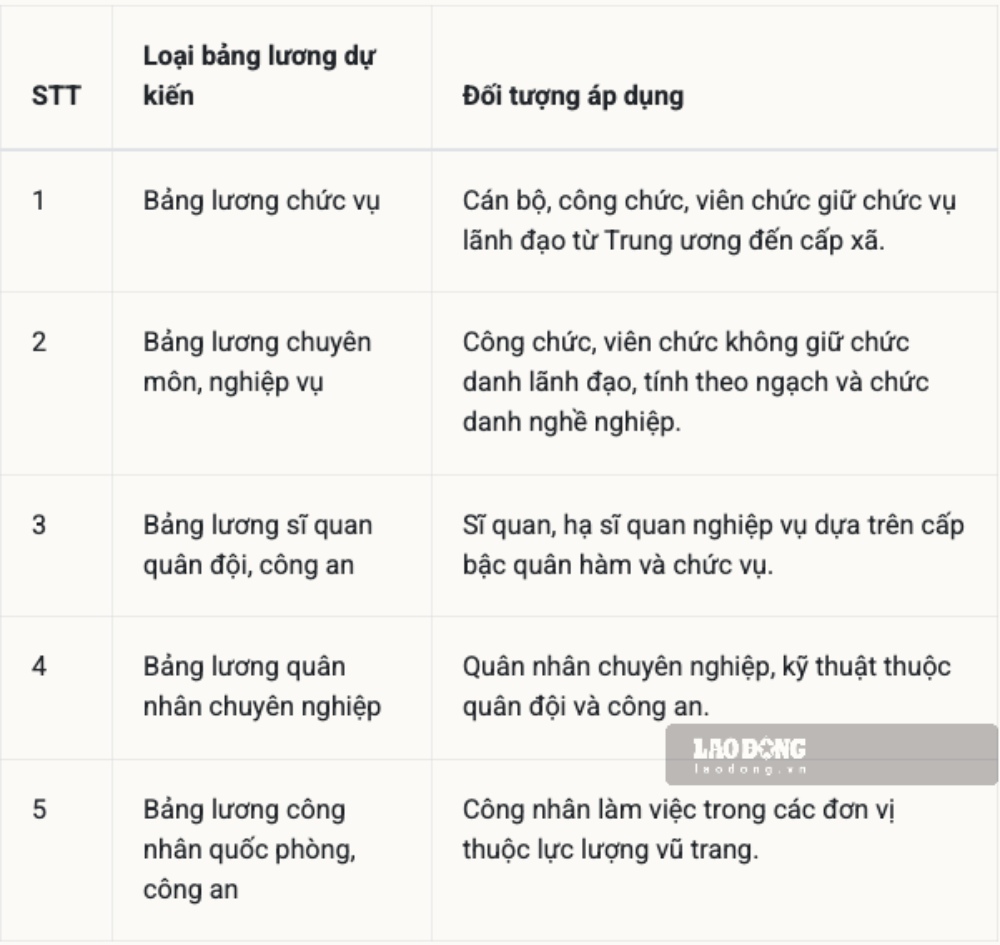
It is expected that there will be 5 new salary scales for the public sector in the spirit of Resolution 27-NQ/TW.
The current base salary is 2,530,000 VND/month, applied from July 1, 2026 according to Decree No. 161/2026/ND-CP.
Clause 3.1, Sub-item 3, Section 2 of Resolution 27-NQ/TW of 2018 specifically stipulates the determination of specific factors for designing a new salary scale.
In which, abolishing the current base salary and salary coefficient, building a basic salary level with a specific amount in the new salary scale.
Implement unified labor contract regimes according to the provisions of the Labor Code for those performing executive and service work, and not apply salary scales for civil servants and public employees to these subjects.
Determining the lowest salary level for civil servants and public employees in the public sector is the salary level of people doing jobs requiring intermediate training level (level 1) not lower than the lowest salary level of trained workers in the business sector.
Expanding salary relations as a basis for determining specific salary levels in the salary scale system, gradually approaching salary relations of the business sector in accordance with state resources.
Completing the regime of regular salary promotion and early salary promotion for cadres, civil servants, public employees and armed forces in accordance with the regulations of the new salary scale.
Regarding the mechanism for managing salaries and income, heads of agencies, organizations, and units are allowed to use the salary fund and regular expenditure funds assigned annually to hire experts, scientists, and people with special talents to perform the tasks of agencies, organizations, and units and decide on the level of income payment commensurate with the assigned tasks.
Heads of agencies, organizations, and units develop regulations to periodically reward subjects under their management, associated with the results of evaluating and ranking the level of work completion of each person.
Expand the application of the pilot mechanism for some provinces and centrally-run cities that have self-balanced their budgets and ensured sufficient resources to implement salary reforms and social security policies, with average income increased by no more than 0.8 times the basic salary fund of cadres, civil servants, and public employees under management.
Public non-business units (DVSNCL) that self-ensure recurrent expenditures and investment expenditures, or self-ensure recurrent expenditures and state financial funds outside the state budget are implemented with a salary autonomy mechanism based on operating results like enterprises.
Private VNUs that self-ensure a part of regular expenditures and private VNUs that are fully guaranteed by the state budget for regular expenditures shall apply the salary regime as civil servants.
The actual salary paid is linked to the job position and professional title of civil servants decided by the head of ĐVSNCL based on revenue, labor productivity, work quality and work efficiency.
Read the original here