

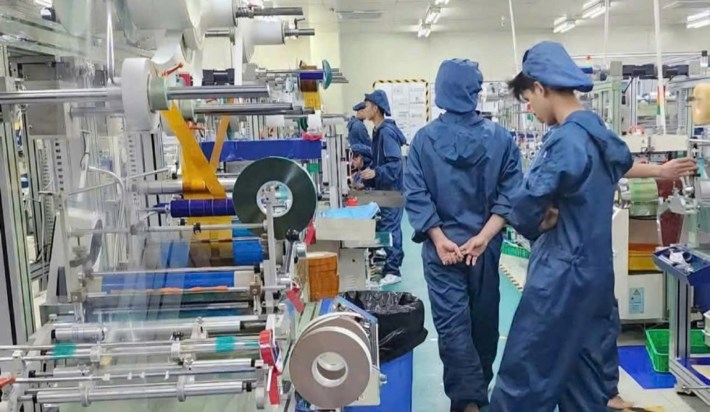
General laborers find it difficult to increase income in the face of the digital transformation wave
General labor is a group with high recruitment demand in urban areas, but most are groups that do not significantly increase income after many years of working.
Machinery increasingly replaces unskilled labor
After nearly 6 years working in the construction sector in Hanoi, Ms. Le Thi Mai (45 years old) still mainly takes on tasks such as transporting materials, supporting construction and completing projects. In the early years of her career, her income was about 7 million VND/month, currently her income is about 9 million VND.
Income has increased but not much. If you want to have more money, you have to take on more work or work overtime," Ms. Mai shared.
Ms. Mai said that at the construction site, she noticed that machinery is being used more and more. Some stages that previously required a lot of labor are now supported by equipment, helping to reduce manpower and shorten construction time.

Machines are becoming more and more modern, but not everyone is trained to operate them. Common laborers like us mainly follow experience, so it is not easy to switch to technical work," Ms. Mai said.
Mr. Tran Van Minh (27 years old) is a packaging staff at a warehouse in Hanoi. His job is to sort, inspect and package orders. Previously, most of the work was done manually, but now, workers have to use additional code scanners and order management software.
The work is still there but the way of doing things has changed, workers must know how to use equipment, otherwise it will be difficult to keep up," Mr. Minh said.
After about 3 years of working, Mr. Minh's current income is about 8 million VND/month. His desire is to move to a position with a better income, but the lack of professional skills makes the process of finding a new job not easy.
Wanting to have the opportunity to increase income, Mr. La Tien Hoang (24 years old, Hanoi) is looking for a new job after working in the service sector. Mr. Hoang said that what he cares about when looking for a job is not only the initial salary but also the ability to learn and develop after entering the business.

Everyone wants a high salary, but if the job does not have the opportunity to study further, after a few years I will still only do the old job. When I want to switch jobs, I have to start from the beginning," Mr. Hoang shared.
According to Mr. Hoang, if a business has a skills training program for employees, he is willing to participate, even if it must start from basic skills.
Eliminating barriers to improving the income of unskilled workers
Mr. Vu Quang Thanh - Deputy Director of Hanoi Employment Service Center said that although accounting for a superior recruitment rate at job transaction sessions in the Capital, unskilled labor is still the weakest and most vulnerable group to market fluctuations.
Especially, when the retail, warehousing and logistics industries promote the application of AI and automation lines, the risk of working hours being cut, even completely eliminated, for the unskilled labor force is more clearly present than ever," Mr. Thanh said.
To help workers overcome the "low-income trap" and avoid the risk of being replaced by technology, Mr. Vu Quang Thanh proposed a core solution to implement a flexible "upgraded training" model on the spot, with close coordination between the three parties.
Businesses proactively "hold hands and guide" by changing their thinking, not considering unskilled labor as a short-term replacement force. Integrating basic digital skills training classes (using warehouse management software, barcode scanners, delivery applications or operating semi-automatic equipment) right in the factory will help workers improve productivity and undertake stages that require higher technology content.
The bridging role of the job service center is promoted through coordination with vocational education institutions to design short-term training courses, flexible in terms of time frame. The goal is to help workers both work and supplement skills certificates, creating a premise for shifting to positions of supervisor, chain manager or elementary technician.
Proactive adaptation from workers. General laborers need to eliminate the psychology of satisfaction with their current manual work, proactively access technology so as not to be pushed to the sidelines of the market.
Digital transformation is not aimed at eliminating the opportunities of unskilled workers, but requires them to change to adapt. When businesses and management agencies accompany and create flexible learning conditions, workers can completely upgrade themselves, move to more sustainable job positions with corresponding income," Mr. Vu Quang Thanh emphasized.
See the original here