

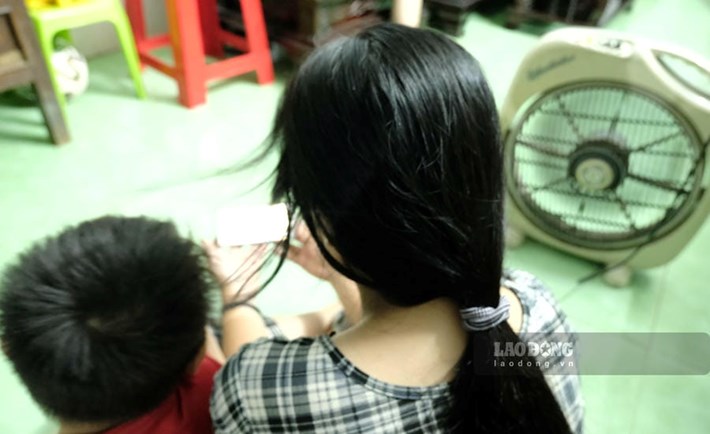
Space in a multi-generational boarding house
Even in working-class families with grandparents from the countryside coming to help, the pressure of making a living and shift work still makes parents have little time to connect with their children.
Rest assured to go to work
For many young workers, welcoming grandparents from the countryside to live together not only helps share expenses but is also a way for them to maintain jobs and stabilize their lives in a foreign land. The family of Ms. Le Thi Diem (30 years old, worker in Tra Noc industrial park, Can Tho City) is such a case.
Ms. Diem's husband works as a security guard in rotation shifts, sometimes in the morning shift, sometimes in the night shift; while she works as a garment worker, often having to work overtime to arrive late. To have someone to take care of the two children, she and her husband had to ask her paternal grandparents from Ca Mau to live with them. The family of 6 shared living in two adjacent rented rooms, with a total rent of 2 million VND/month, including electricity, water and wifi.
Having grandparents living together, my husband and I are completely reassured, we don't have to struggle to find a place to send our children outside of work hours or frantically run back to pick up our grandchildren when the company requires overtime. Grandparents are close to their grandchildren, so their homesickness is also eased" - Ms. Diem shared.
Working as a freelance construction worker in Can Tho City and having to raise his child alone, Mr. Nguyen Hoang Tan (32 years old, from Vinh Long) also has to ask his grandparents who are over 60 years old to help take care of his grandchildren. "The whole family is crowded in a rented room of about 20m2. From meals, sleep to picking up and dropping off the two children to school, everything depends on the grandparents. The presence of the grandparents helps me have more time to work, but also means that the elderly have to shoulder most of the childcare in poor living conditions" - Mr. Tan confided.
Irregular lifestyle, parents have little time with their children
Having grandparents supporting housework and taking care of children is lucky for many working families. However, the cramped rented space and odd-shifted working hours make the time parents spend with their children increasingly limited.
At the rented room of Ms. Diem and her husband, continuous overtime makes both of them have little time to meet and chat with their children. Ms. Diem sadly shared: "Being busy working to take care of the family, the children are also gradually becoming distant. My eldest daughter confides in her grandmother about any problems, sometimes a mother like me doesn't even know, I have to wait for her to tell me again to know.
Meanwhile, Mr. Tan is not only worried about the cramped living conditions in his 20m2 rented room but also resentful of his children's circumstances. According to Mr. Tan, due to his old age, his grandparents also find it difficult to take their grandchildren out to play or participate in many outdoor activities. Meanwhile, he is often absent from home due to work, so the time spent with his children is also limited.
Even with grandparents' support and care, the children still lack time to play and interact with their parents. Many times I thought about sending my children back to the countryside to have a better living space, while I rent a cheaper room or live with colleagues to reduce costs. However, thinking about having to be away from my children, I couldn't bear it" - Mr. Tan confided.
The lives of workers' families of 2-3 generations in boarding houses are therefore always accompanied by difficult choices. Grandparents are a support to help parents maintain their jobs, but the limited living space, livelihood pressure and prolonged working hours still pose a problem of care conditions and connection between family members.
See the original here