

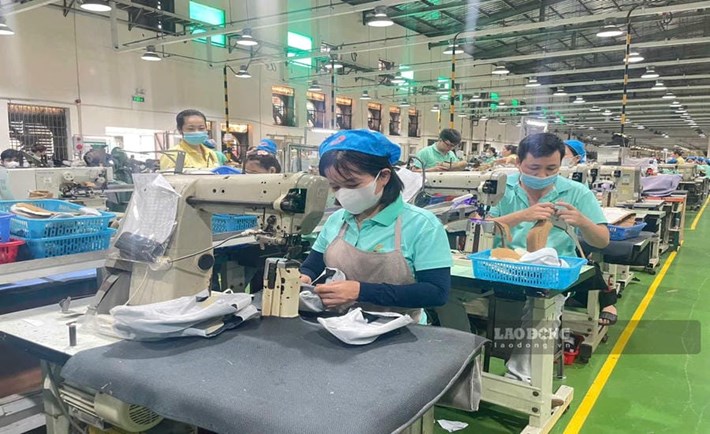
The journey to find a stable home for workers in Ho Chi Minh City
Millions of migrant workers in Ho Chi Minh City are struggling every day in cramped, dilapidated rented rooms that have not yet reached their dream of settling down because of high house prices and limited supply.
Struggling to cling to the cramped corner of the rented room
For more than 10 years, the 16m2 attic room in Tay Thanh ward has been the residence of Ms. Tran Thi Thu Thao's family (35 years old, from Quang Tri). Working as a worker with an income of less than 10 million VND/month, she has to calculate each expense. Because she needs to pick up her children to school on time, she cannot accept overtime. The total income of more than 15 million VND/month of the couple is only enough to cover tuition fees, rent and minimum living expenses.
In the cramped room, all activities are maximized. In the evening, when motorbikes are brought into the house and mattresses are spread, the walkway is almost gone. To give her child a place to study, she gives up the attic, and the couple lives downstairs. Although cramped, Ms. Thao's family still chooses to stay because they do not have enough capacity to rent a larger place and want to stabilize their child's studies.
“I have been here for many years with acquaintances, and when needed, I even ask them to look after the children. My monthly income is enough for expenses, if I don't owe anything, I'm happy; if I have an extra 1-2 million VND, it's hard to think about buying a house in the city,” Ms. Thao shared.
In the same situation, Ms. Doan Thi Tuyen Chi (30 years old, Tay Thanh ward) has also been attached to the boarding house for 5 years. The room is so cramped that she has to install a kitchen sink herself, and the attic is only for storing things. Without a place to play, her child only stays with a small bicycle in front of the row of boarding houses.
In the rented area in Tan Hung ward, Ms. Nguyen Ngoc Hoang's 5-member family lives in a 15m2 room without an attic. The room is cramped, making the toilet also a place to wash dishes and clothes. Every year, the rented room is flooded 2-3 times when heavy rain combines with high tide.
Ms. Hoang confided: "Life is difficult, so the dream of having a large house with space for children to study and develop is too difficult. The cost is tight, so my husband and I just try to live temporarily in this rented room.
Expecting opportunities to access social housing
High house prices and limited supply are the main reasons why many workers cannot reach their dream of settling down.
Having lived and worked in Ho Chi Minh City for more than 10 years, Ms. Tran Thi Hoa Ly (39 years old, from Nghe An) hopes to have the opportunity to buy a social house for about 300-400 million VND to stabilize her accommodation.
Similarly, Mr. Do Van Kien (40 years old, from Phu Tho) came to Ho Chi Minh City to work as a worker in My Phuoc 2 industrial park (Ben Cat ward) for more than 10 years but has not been able to buy a stable house to live in. Mr. Kien said that high house prices have prevented his family from buying a house. Currently, 4 people still live in a rented room of about 25m2 and hope to soon buy a social housing to settle down in Ho Chi Minh City for a long time.
Accompanying the workers' wishes, Mr. Dao Quang Tho - Human Resources Director of Cua Y A Chau Technology Co., Ltd. - a business with about 1,400 workers (mostly immigrants) - shared: Many workers want to buy houses to live and work in Ho Chi Minh City. However, currently housing prices are quite high, so workers have difficulty accessing them. Social housing projects in Tan Hiep ward are very few, so workers do not have many opportunities to access housing.
I propose that the State implement more large-scale social housing projects in Tan Hiep ward and neighboring wards. In addition, the price must also be suitable for workers' pockets" - Mr. Dao Quang Tho said.
In An Phu ward, Thong Dung Shoe Co., Ltd. has about 4,000 workers and laborers. Mr. Nguyen Minh Tien - Chairman of the Company's Trade Union - said that most workers are migrant workers. Only a few long-term workers have bought land to build houses, and the majority are living in rented houses. Workers live in rows of boarding houses near factories for convenient work. The Trade Union also recorded many workers wanting to buy social housing to stick with Ho Chi Minh City. However, according to Mr. Nguyen Minh Tien, currently social housing projects are still few, and the resale price is quite high, so workers at the company have difficulty accessing them.
Solving the housing problem from real "payment capacity
Mr. Vo Khac Thai - Standing Vice Chairman of the Ho Chi Minh City Labor Federation - said that initial surveys show that the housing needs of union members, workers, and laborers are very large: There are about 3,181 cases with housing rental needs and 30,339 cases with rental and purchase needs for social housing. Through actual surveys, most workers are renting rooms in spontaneous residential areas, conditions on area, safety, fire prevention and fighting, and social infrastructure are still limited.
According to the Ho Chi Minh City Labor Federation, the biggest obstacle is not only house prices but also the ability to balance monthly spending. Limited income, while having to cover many expenses, makes it difficult for workers to access social housing, even with preferential credit. The social housing loan interest rate at the Vietnam Bank for Social Policies is currently at 5.4%/year. However, the Ho Chi Minh City Labor Federation believes that it is necessary to develop housing suitable for affordability, especially rental and lease-purchase houses; and at the same time have long-term credit and appropriate interest rates to reduce pressure on workers.
To date, the Labor Federation has signed cooperation agreements with 9 enterprises, with a total of about 128,000 houses expected to be developed by 2030. This is a very important social resource, but clearly defining this as a commitment and a planned list, does not mean the number of houses that have been started or completed.
In fact, the progress of projects is currently uneven. Some projects have basically completed dossiers and are expected to start construction; for example, the Hoa Sen An Ha project is expected to start construction in the fourth quarter of 2026 with 1,853 apartments in Tan Vinh Loc commune. Some other projects are completing procedures and are expected to start construction in 2027; while some businesses are continuing to research and find suitable land funds.
Our point of view is not to let the agreements stop at signing. Therefore, the Trade Union is shifting from the "connection, signing" method to "connection - monitoring - removal - monitoring progress"" - a representative of the Ho Chi Minh City Labor Federation emphasized.
Efforts from landlords and strict financial problems
Understanding the circumstances of poor workers, in a boarding house in An Phu Dong ward (HCMC), Mr. Nguyen Thanh Tam built a series of boarding rooms with areas from 14m2 to 27m2 (including attic) with affordable rental prices ranging from 1.4 million to 2 million VND/month.
To improve the living environment for tenants, Mr. Tam has greened the space with ornamental plants and invested in installing 204 solar panels on the roof of the rented room with an area of about 600m to both provide domestic electricity and help reduce the temperature for the rented rooms below.
However, Mr. Tam said that infrastructure upgrades face many difficulties due to high costs. A complete rented room can currently cost 150-200 million VND; after calculating loan interest, depreciation and taxes, the profit from renting at 2 million VND/month is only a few hundred thousand VND. According to him, maintaining rents below 2 million VND/month is a great effort by landlords to share difficulties with workers.
Any landlord wants to build a spacious and modern environment for workers, but the financial problem is really very strict. If we try to invest in more large infrastructure utilities, rents will have to increase accordingly, and if prices increase, how can poor workers and workers bear it? That is why very few investors are interested in the cheap rent segment" - Mr. Tam emphasized.
See the original here