
Khanh Hoa trains negotiation skills for commune and ward trade union officials
Khanh Hoa - Provincial Labor Federation organizes training to improve capacity for commune and ward trade union officials in negotiating with businesses.
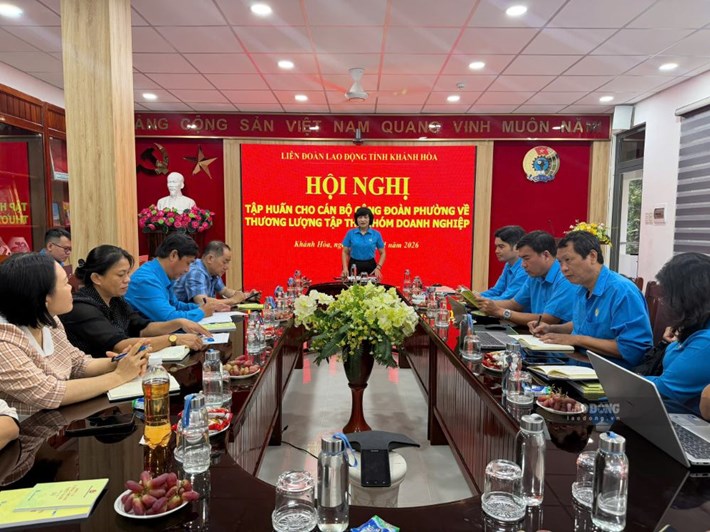
On November 4th, the Standing Committee of the Khanh Hoa Provincial Labor Federation organized a training conference on negotiation, signing and implementation of collective labor agreements (CLAs) of enterprise groups at trade unions in communes and wards.
At the conference, students were exposed to 4 topics, including: Overview and legal framework on collective labor agreements of enterprise groups; negotiation and signing processes and key contents of agreements.
In addition to the theory part, the program focuses on practice through group exercises and simulated situations.
Trainees analyze the actual data of 3-5 businesses to find common points, thereby developing a draft collective labor agreement.
Trainees also participate in playing the role of negotiation sessions between trade union representatives and business representatives.
Through this activity, trade union officials are trained in the skills of presenting proposals, handling different opinions and finding unified solutions.
This is also an opportunity for students to exchange practical experiences and choose appropriate applications to the situation at the grassroots level.
According to Ms. Tran Thi Huong - Vice President of the Khanh Hoa Provincial Labor Federation, the whole province currently has more than 1,000 grassroots trade unions.
After deploying the 2-level local government model, trade union officials in communes and wards are still new and need to be equipped with more knowledge and skills to perform tasks well.
Previously, the Standing Committee of the Provincial Labor Federation had developed a plan to promote dialogue and collective negotiation in 2026.
The goal is to improve the effectiveness, quality and coverage of dialogue and negotiation activities.
At the same time, pilot models suitable for the reality of labor relations, including collective labor agreements for many businesses.
The training helps commune and ward trade union officials grasp legal regulations, proactively understand the needs of workers, support grassroots trade unions in developing proposals and exchanging with businesses about practical contents.
Thereby, contributing to improving working conditions, protecting the legitimate and lawful rights and interests of workers, and building stable and harmonious labor relations at enterprises.
See the original here