


Creating a social security support for millions of informal workers when losing their jobs
Expanding the coverage of unemployment insurance and strengthening job connections is a necessary direction to create a social security foothold for informal workers.
Laborers lack support when losing their jobs
According to data from the Statistics Office (Ministry of Finance), in the third quarter of 2026, the proportion of informal workers in Vietnam was 60.6%. In the first 9 months, the whole country had 32.4 million informal workers, accounting for 61.5% of the total number of employed workers.
This group mainly works in fields such as: small trading, freelance services, seasonal workers, technology motorbike taxis, domestic helpers... The common characteristic is unstable income, lack of labor contracts and limited access to insurance policies.
Because most are not eligible for compulsory unemployment insurance, many informal workers do not have a foothold from this policy when they lose their jobs.
They do not receive unemployment benefits under the insurance mechanism, and it is also difficult to access job search support services and vocational retraining through policies. When income is interrupted, workers have to fend for themselves against economic risks.
According to Assoc. Prof. Dr. Nguyen Thi Lan Huong - former Director of the Institute of Labor Science and Social Affairs (Ministry of Home Affairs), one of the major limitations of the current unemployment insurance system is that there are no suitable solutions for the informal sector.
We have built a relatively complete unemployment insurance system for the formal sector, but there are no suitable solutions for the informal sector - where the most vulnerable workers are concentrated," Ms. Lan Huong assessed.
According to experts, this gap makes policies not fully promote the role of protecting workers, and at the same time may increase inequality in access to social security between labor groups.
Therefore, expanding the coverage of unemployment insurance not only helps workers have more support when losing their jobs but also creates motivation for them to participate in the formal sector, contributing to improving the quality of the labor market, productivity and promoting sustainable growth.
Increase job connection, protect workers
From the reality in Hanoi, Mr. Vu Quang Thanh - Deputy Director of Hanoi Employment Service Center, said that units are gradually shifting from the main approach of paying unemployment benefits to strengthening counseling, job introduction, vocational training support and connecting workers with businesses.
One of the goals is to build a database that closely follows the market, reflecting industry fluctuations, recruitment needs and labor cuts. Through this, workers are streamed from the beginning according to their needs to continue looking for jobs, changing careers or participating in training and improving skills.
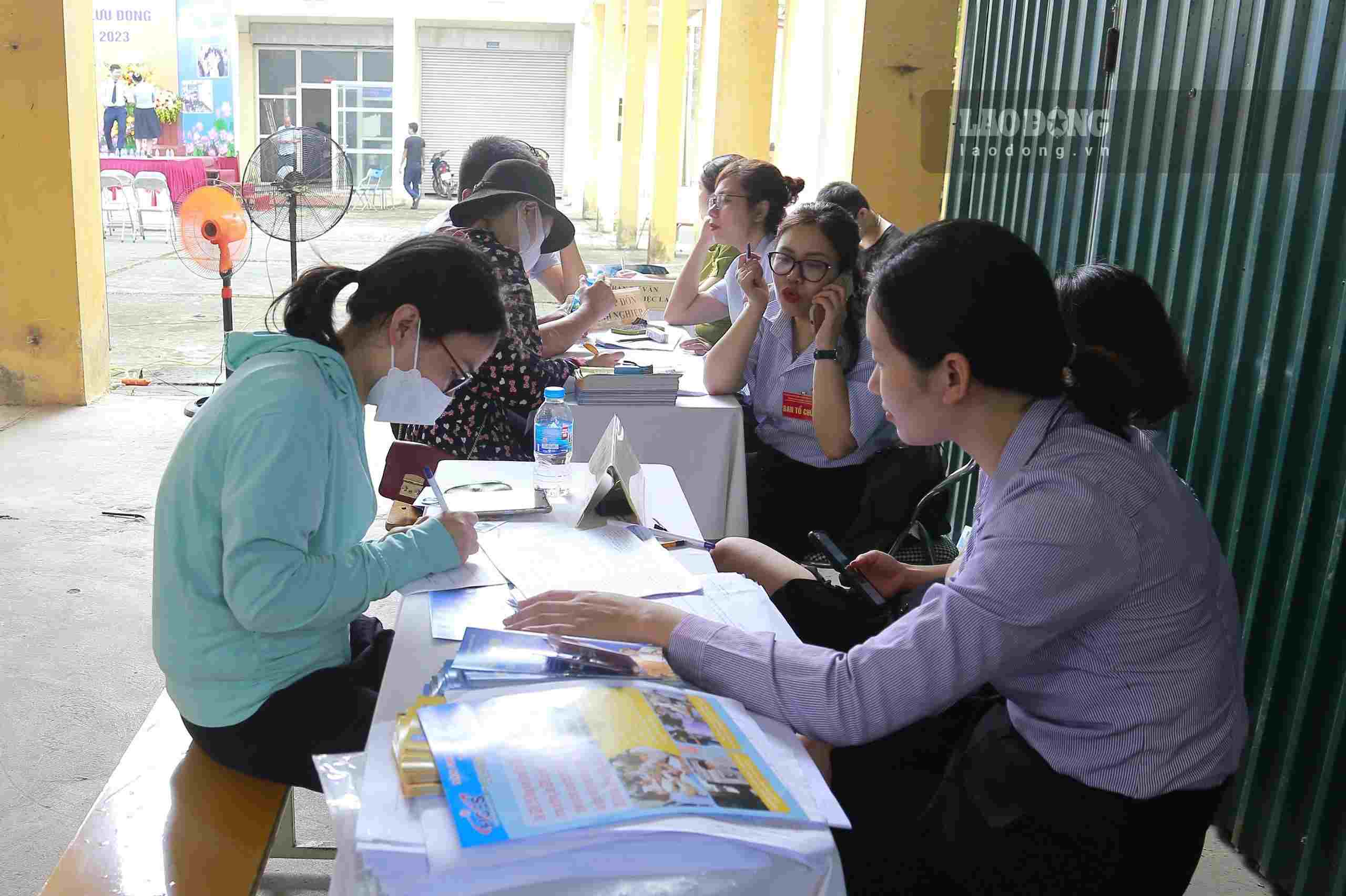
Job connection activities are implemented in many forms, from regular counseling, periodic job transaction sessions, thematic sessions by labor group or industry to online job transactions between Hanoi and provinces and cities. The Center also promotes digital transformation in receiving dossiers, online counseling, providing recruitment information and connecting workers with businesses.
According to Mr. Vu Quang Thanh, the process of providing and coordinating labor market information includes collecting supply and demand data; summarizing and analyzing according to qualifications, skills and job positions; organizing consulting, introducing, and connecting jobs; building information products to serve workers and businesses.
However, labor market data has not been fully interconnected between agencies and units, and the update speed has not kept up with actual fluctuations. This may cause warning information about labor shortages in industries, industries with a tendency to cut staff, or industry groups with large recruitment needs not to reach all parties in time.
He believes that it is necessary to shift from simple connection to proactively regulating labor market information, improving analytical and forecasting capabilities to respond to changes in technology, economy and human resource demand.
Along with that, it is necessary to simplify administrative procedures, increase the application of technology and expand digital channels so that workers and businesses can access services more conveniently.
See the original here