

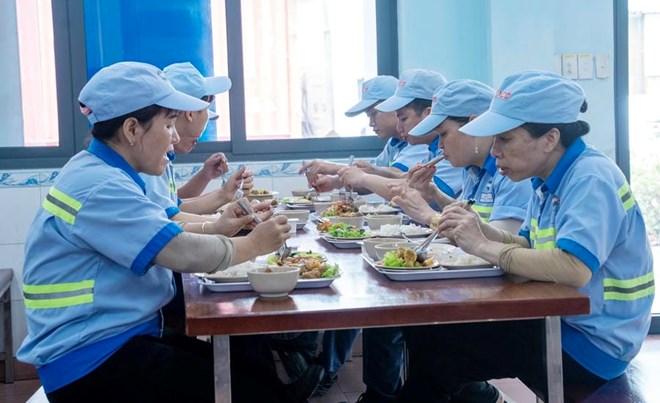
42,393 enterprises and units with grassroots trade unions support lunch meals for workers
After 10 years of implementing Resolution 7c/NQ-BCH, the Trade Union has gradually improved the quality of lunch meals through dialogue, negotiation and supervision.
According to the Labor Relations Department of the Vietnam General Confederation of Labour, implementing Resolution No. 07c/NQ-BCH and 5 years of implementing Conclusion No. 03/KL-BCH on "Quality of lunch meals for workers" of the Executive Committee of the Vietnam General Confederation of Labour, trade union levels have included the content of improving lunch meal quality in the work program, care plan, Workers' Month activities, Action Month on occupational safety and health, implementation of grassroots democracy regulations, dialogue and collective bargaining.
Many units issued thematic plans, organized training, guided grassroots trade unions to survey the value of meals, collected workers' opinions and developed negotiation plans.
An important turning point is the approach of gradually shifting from the thinking of mobilizing businesses to "care about meals" to identifying this as a specific content of the function of representing and protecting the legitimate interests of workers.
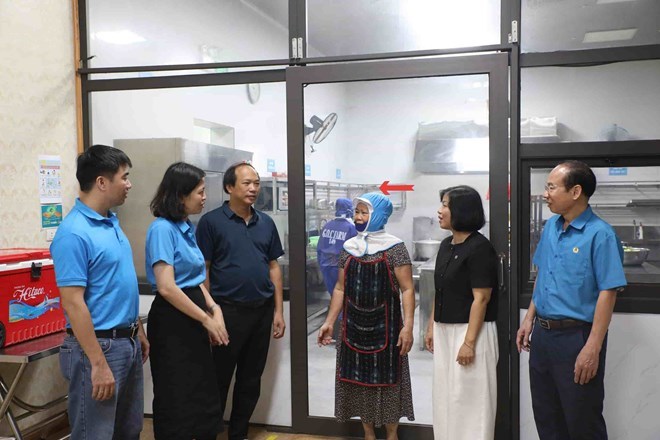
Upper-level grassroots trade unions also regularly organize training for grassroots trade union officials on skills in dialogue, negotiation, and content of collective labor agreements (CLAs); and at the same time coordinate with functional agencies in the area to inspect food safety issues, kitchen conditions and the implementation of commitments made in collective agreements.
Some localities maintain an annual coordination mechanism with labor, health, social insurance and Fatherland Front agencies to inspect and supervise businesses. This approach helps link improving lunch meals with the implementation of labor laws, occupational safety and health, democracy regulations and quality of labor relations, instead of separating lunch meals into a single welfare activity.
According to existing aggregated data, by 2026, there are 42,393 enterprises and units with grassroots trade unions implementing policies to support lunch meals for employees, equivalent to 64.63% of a total of 65,599 enterprises with grassroots trade unions; about more than 6,947,850 employees benefit. This is a large-scale benefit, reflecting the issue of lunch meals that have become a common concern in the business sector with Trade Union organizations.
The forms of implementing "shift meals" are quite diverse: Some businesses organize on-site cooking; some places hire businesses to provide industrial meals; some places directly pay money for workers to take care of meals themselves; partially support costs or apply forms suitable for scattered workers. This diversity reflects the characteristics of labor organization between industries and areas that are very different.
The Labor Relations Department of the Vietnam General Confederation of Labour said that the units submitting reports show clear differences by area. Dien Bien has 20/39 grassroots trade unions implementing lunch meals; Lang Son has 55 units with 1,037 union members and workers benefiting; Ha Tinh from 151 enterprises in 2016 with an average level of 11,000 VND/meal has increased to 424 grassroots trade unions organizing or supporting lunch meals; Phu Tho has over 90% of enterprises with trade union organizations organizing or paying lunch meals; Vinh Long has 431/607 enterprises organizing lunch meals, reaching 71%. Dong Thap reported that about 69% of enterprises with trade union organizations have organized lunch meals. These data show that the trend of expanding coverage is clear, but the level between localities is still largely different.
For industries with scattered labor characteristics such as railways and construction, organizing centralized kitchens is not always suitable; therefore, supporting with money, organizing at the construction site or applying norms according to positions and shifts is a practical solution.
In the defense enterprise sector and some concentrated manufacturing industries, the organization of meals is maintained relatively orderly, associated with working conditions, production discipline and health assurance requirements...
On October 8th, the VGCL organized a workshop to collect opinions on the draft report summarizing 10 years of implementing Resolution 7c/NQ-BCH and 5 years of implementing Conclusion 03/KL-BCH on "Quality of lunch meals for workers".
The workshop was attended by leaders of the Labor Relations Department of the Vietnam General Confederation of Labor; representatives of central industry trade unions, economic group trade unions, corporation trade unions directly under the Vietnam General Confederation of Labor, and Labor Federations of provinces and cities. The workshop was organized in the form of live and online.
At the workshop, delegates contributed opinions to "Summary report on the results of surveying and evaluating the implementation of Conclusion 03/KL-BCH on "Quality of meals for workers"; draft report summarizing 10 years of implementing Resolution 7c/NQ-BCH and 5 years of implementing Conclusion 03/KL-BCH; draft Resolution "On improving the quality of meals contributing to protecting and improving the health of union members and workers in the period 2026 - 2031"...
According to the Labor Relations Department of the Vietnam General Confederation of Labour, the workshop aims to assess the results, limitations, causes and lessons learned in implementing Resolution 7c/NQ-BCH and Conclusion 03/KL-BCH; and at the same time, receive recommendations, propose goals, tasks, and solutions to build a replacement resolution, submit it to the Standing Committee and the Executive Committee of the Vietnam General Confederation of Labour for consideration and decision, expected to be applied from the beginning of 2027.
See the original here