

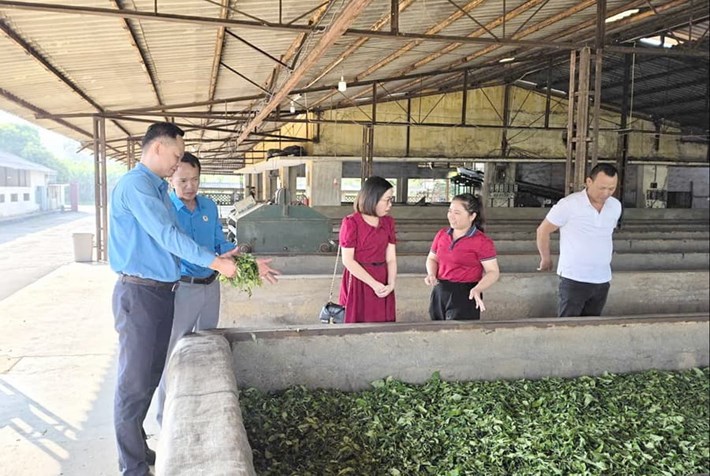
Retaining workers in tea areas with practical policies
Trade unions of tea enterprises are contributing to retaining skilled workers amidst the difficulties of seasonal production.
Nghia Lo Tea Joint Stock Company (Lao Cai) currently maintains a labor force of 66 people, of which the proportion of female workers is dominant with 68.18%.
The specific characteristics of black tea export production make the company's operations heavily affected by seasonality. Harsh weather at the beginning of the year reduces fresh bud production, combined with global market fluctuations and high sea transportation costs, making tea consumption difficult.
At the end of the harvest season, the factory stopped operating, workers lacked jobs and income was precarious.
Faced with that situation, the Executive Committee of the Trade Union of Nghia Lo Tea Joint Stock Company has proactively coordinated with the Board of Directors to find solutions to ensure the core rights of employees.
100% of employees when signing labor contracts are propagated and mobilized to join trade union organizations. The unit commits to building wage norms higher than the regional minimum level and fully deducting social insurance, health insurance, unemployment insurance as well as organizing periodic health checks for all employees.
In 2025, although trade union financial revenue was still limited, the unit spent up to 50.7 million VND directly on caring for, protecting, visiting and subsidizing workers.
This is the largest proportion of the trade union budget, showing the spirit of "all for union members".
Although the force of trade union officials is 100% part-time and the work of gathering union members in the idle season is still difficult, the company's trade union has persistently proposed to the company's leaders and owners to maintain specific support policies for union members and employees to retain skilled workers, ensuring the continuity of the unit must produce seasonally.
At the Trade Union of Tran Phu Tea Joint Stock Company (Lao Cai), the unit has 48 workers specializing in producing and processing black tea for export in Thuong Bang La commune, nổi bật with representative and collective bargaining activities.
From October 2025, a collective labor agreement will be signed with many clauses beneficial to workers such as 100% meal allowance, provision of soft drinks on hot summer days, and full payment of 3-day annual travel expenses for workers.
Along with that, the trade union regularly cares for the lives of union members. In the past year, 33 turns of union members in difficult circumstances were visited and subsidized with a total amount of 33 million VND.
On the occasion of Tet At Ty 2025, grassroots trade unions were supported by the Vietnam Union of Agriculture and Environment to give Tet gifts to 20 union members, workers and 1 case of critical illness, with a total value of 21.5 million VND.
Women's work and care for workers' children are also maintained. With 26 female union members, the union organizes activities on International Women's Day March 8th and Vietnamese Women's Day October 20th with a budget of more than 12.1 million VND; and at the same time gives gifts and rewards to workers' children with good achievements in studying and social activities on June 1st and Mid-Autumn Festival occasions.
The implementation of democracy at the grassroots level is emphasized through employee conferences and 2 direct dialogues at the workplace, contributing to solving problems arising in the production process.
However, trade unions at tea enterprises in mountainous and highland areas still face difficulties because trade union officials are mainly part-time, working in shifts, seasonally, with limited funding and the application of information technology in trade union activities is still new...
See the original here