

Grandparents become a rear for worker families
Many grandparents leave their hometowns to live together, take care of their grandchildren, manage their families so that workers' children can feel secure at work and stick to the city.
Old age days with children's voices
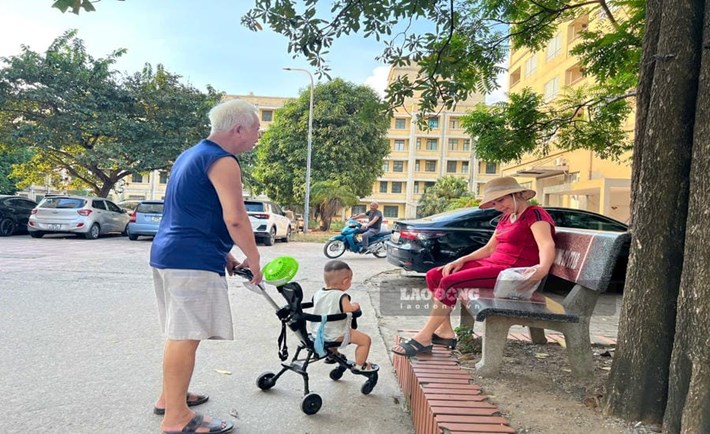
In the late afternoon at Kim Chung worker housing area (Thien Loc commune, Hanoi), many grandparents over 60 years old took their grandchildren down to the yard to play, patiently watching every step of their children.
Ms. Nguyen Thi Hoa (from Nghe An), 66 years old, is taking care of her 13-month-old grandchild. Her two children have been working as workers at Thang Long Industrial Park for more than 10 years. Her son has two children, one child is in 1st grade, and the younger one still cannot walk steadily.
Her day starts at 5:30 am. She wakes up to prepare breakfast for the grandchildren, takes the eldest grandchild to public school and then rushes home to take care of personal hygiene and breakfast for the youngest grandchild. After that, she stays at home to take care of the grandchild until the end of the day.
Her son and his wife work in shifts, so they often have to alternate working hours, and when possible, they also support her in taking care of the child. But most of the time in the day, taking care of the child still falls on the grandmother's shoulders.
Looking at children is very tiring, because we always have to pay attention and follow every step. Especially when the child is learning to walk, just being a little careless is easy to fall" - Ms. Hoa shared.
At the age of 66, she understands that she also needs some rest time. However, for her, taking care of grandchildren is not only to help her child reduce the burden but also a way for the family to work together to build life.
She said, old age is sometimes tiring, but seeing her children feel secure going to work, and her grandchildren are well taken care of, she tries again.
Family members, if each person tries a little, it will be peaceful" - Ms. Hoa said.
Ms. Hoa's story is not an isolated case. In the dormitories of workers around industrial parks, occasionally you can see grandparents from the countryside coming down to live with their children to look after their grandchildren.
Sending to grandparents to rest assured to stick with
In a rented room of just over 10m2 in Hau Duong village, Thien Loc commune, Ms. Tran Thi Hien (from Phu Tho province), 64 years old, has become the main grandchild caregiver in the family.
Since her daughter-in-law finished her 6-month maternity leave and returned to work, she has moved in to live with her to look after her grandchild. Up to now, the child is 11 months old.
Mrs. Hien's day revolves around seemingly small but continuous tasks: feeding her grandchild, mixing milk, personal hygiene, lulling her to sleep, playing with her grandchild and then cleaning the house. Young children are hyperactive and always need adults to keep an eye on them, so she is almost always busy.
The cramped living space makes taking care of a child even more difficult. However, what Ms. Hien is most worried about is not being in a small room or having to wake up many times a day.
She is only afraid that her grandchild will lack space to exercise, play and develop.
Her presence not only helps children have more people to take care of children. Behind a worker who can confidently start their shift is a mother, a father who is behind taking care of meals, sleep, pick-up and drop-off, and the daily needs of children.
For worker families working in shifts, that support becomes even more important. When parents have to go to work together, morning shifts follow evening shifts, time spent with children is divided, grandparents become a link to help the family maintain the rhythm of life.
They take care of their grandchildren so that their children can feel secure at work. They manage unnamed tasks so that their children are less stressed. And many times, it is the presence of grandparents that helps worker families to continue to stick to the city, instead of having to face the choice of someone to quit their job to take care of their children.
Looking at it from a broader perspective, it is also a very ordinary expression of family culture. Not grand things, family culture is sometimes created from the way each member shares a part of responsibility with each other, knowing where this person is in difficulty so that the other person can share the burden.
See the original here
- Lao Dong Newspaper readers support grandparents in raising 3 orphaned grandchildren and a man with hemiplegia
- LD26155: Heartbreaking scene of two disabled brothers relying on their elderly paternal grandparents
- Giving support from Lao Dong readers to elderly grandparents raising disabled granddaughter