

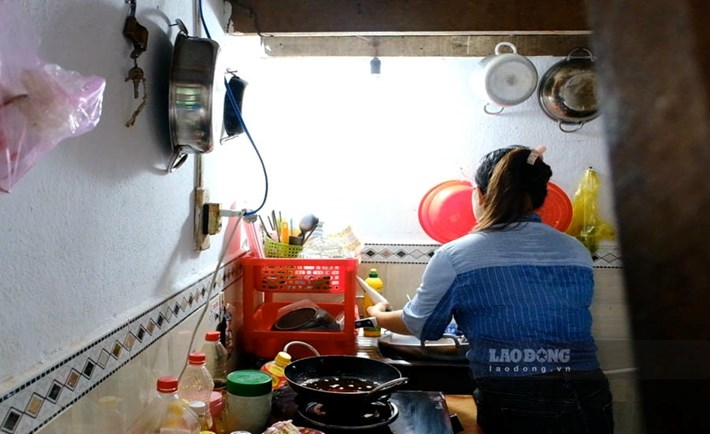
Cramped boarding houses, children lack playgrounds
After many years of working far from home, many workers still live in cramped rented rooms, waiting for the opportunity to own a home suitable for their income. Living in small rented rooms, workers' children lack places to play and exercise after school hours.
The family of Mr. Truong Van Vinh and Ms. Truong Thi Hong Lan (Dong Thap province), after 15 years living far from home, still does not have their own home. The couple currently lives with their two young children, 10 years old and 3 years old, in a rented room of about 16m2 in Vinh Long, which is both a place for four members to sleep and rest, and a study corner for their children.
The couple's total income is about 18 - 19 million VND/month. In which, Mr. Vinh has an income of about 11 million VND, Ms. Lan about 7 - 8 million VND. The rent, electricity, and water alone are more than 2 million VND/month, the rest must be spent on raising two children and supporting both parents.
Mr. Vinh said that about 2 years ago, his family registered to buy a social housing project at a worker housing project. However, until now, the family still has to continue living in a cramped rented room, while the need for a stable place to live is becoming increasingly urgent as their children grow up.
Because his parents in the countryside are old and weak, Mr. Nguyen Huy Hoang and his wife (workers in Tra Noc Industrial Park, Can Tho City) had to bring their young child to live in the same rented room. According to Mr. Hoang, bringing their child to live together helps the couple conveniently take care of them.
However, the thing that worries the male worker the most is the lack of living and entertainment environment for his children after school hours.
The rented room is small, just enough minimum living space for the family. Although there is a common yard around the rented room area, it is always crowded with vehicles passing by, which is very dangerous, so I don't dare to let my children play for long" - Mr. Hoang shared.
Therefore, if he wants to take his children to parks or public amusement parks, Mr. Hoang often has to wait until the weekend. However, on overtime days, coming home late and tired, taking his children out to play is also put aside.
Similarly, Ms. Le Thi Tuyet and her husband (workers in Tra Noc Industrial Park, Can Tho City) are currently living with 2 young children in a rented room of about 20m2.
According to Ms. Tuyet, if renting a spacious and more comfortable room, the cost will be high, while workers' salaries also have to cover many worries.
Mr. Nguyen Phuc Linh - Member of the Executive Committee of the Vietnam General Confederation of Labor, Provincial Party Committee Member, Vice Chairman of the Provincial Vietnam Fatherland Front Committee, Chairman of Vinh Long Provincial Labor Federation - said that taking care of housing for workers is the central task of the Trade Union organization.
Through surveys, Long Duc Industrial Park has 2,493/4,094 people, accounting for 60.89%, with a need to rent social housing; Hoa Phu Industrial Park has 1,447/6,344 people, accounting for 22.8%, with a need.
In Long Duc, a land area of nearly 20,000m2 has been filled, creating conditions for the deployment of social housing associated with trade union institutions.
Mr. Duong Van Phuc - Director of Vinh Long Provincial Department of Construction - informed that the whole province currently has 26 social housing projects with a total scale of 9,269 units. However, some projects are still behind schedule due to difficulties in financial resources, handling inspection conclusions and procedures to confirm beneficiaries of policies.
The Construction sector has advised the Provincial People's Committee to review and propose adjusting the social housing development target for the period 2026 - 2030 to 20,500 units. From now until the end of 2026, the province is expected to complete an additional 470 units and start construction of 1,581 new units.
For worker families with young children, a suitable house not only helps reduce the pressure of rent but also creates a stable space for children to study and live. From 16m2 rooms, the desire to have a place to settle down is therefore still a practical need of many workers working in industrial parks.
Although meeting the immediate accommodation needs for workers' families, the current boarding house model still leaves a large gap for a true living environment, where children lack space for learning, entertainment and development.
See the original here