

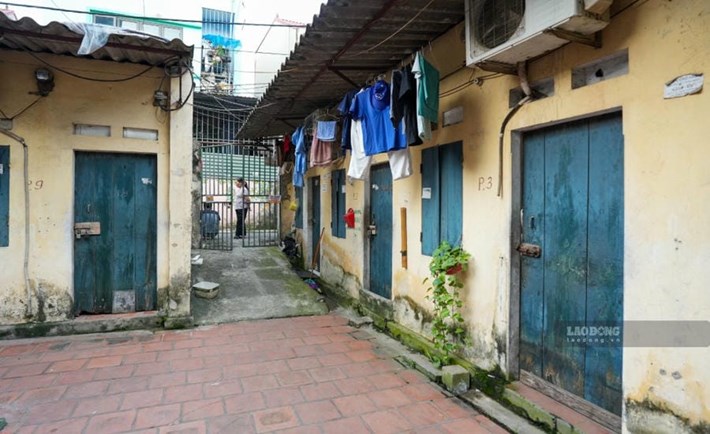
Cramped rented rooms and the dream of a warm home for workers
Pressure on rent, causing many workers to accept small rooms, affecting family life and activities.
The room is enough to live in, but not enough to live in
Thang Long Industrial Park gathers a large number of workers, leading to many rented rooms interspersed in residential areas.
Rent depends on the area and quality of the room. Closed rooms usually cost 1.3-1.5 million VND/month, newly built rooms cost about 1.8 million VND/month, while old, degraded rooms cost 500,000-700,000 VND/month and are the choice of many low-income workers.
Ms. Nguyen Thi Trang, from Tuyen Quang, used to be a component assembly worker at Thang Long Industrial Park. More than 10 years attached to the job, she has also lived in rented rooms around the industrial park for those years.
At one point, she rented a room of about 15m2 for 1.5 million VND/month. Four people live together in that small space, including her husband and wife, mother-in-law and young child. Another child of hers had to be sent to the countryside.
The room only fits a bed. Below is a mattress for the two grandmothers and grandchildren. The small kitchen corner is filled with a gas stove. The toilet is closed, almost no space left for other activities.
In summer, the room is hot and stuffy. On rainy days, humidity increases, walls and furniture are easily damp and moldy. Mosquitoes and insects appear more often.
What worries Ms. Trang the most is not the cramped living, but the feeling that her children do not have a proper space to grow up.
There, a child does not have a yard to run around playing. The study corner is also difficult to separate from the sleeping place and eating place. Every time adults rest, children's activities must also be adjusted accordingly.
After more than 10 years of working as a worker, Ms. Trang decided to return to her hometown.
Income in the countryside is lower, job opportunities are also not as good as Hanoi. But in return, she has a wider space to live with her family. Children have places to play and study. The seemingly very normal activities of a family no longer have to be calculated by square meter.
Returning to the countryside has lower income, but at least there is a place to live in the true sense, with space for children to play and study" - Ms. Trang shared.
When a room cannot become a roof
Ms. Duong Thi Chung once rented a room for 700,000 VND/month. The rent is suitable for the financial capacity of workers, but the room has seriously deteriorated. Living in that room makes her have to consider every small activity.
After a while, she decided to move to another room that was more airy, with a price of 1.6 million VND/month. The rent increased more than double, meaning that part of the income had to be spent on accommodation. However, the new room has not yet solved all the inconveniences.
Drying clothes must take advantage of the spaces in the room. When the weather is humid, clothes take a long time to dry, and the smell of mold easily lingers.
What makes Ms. Chung feel sad is her children. Because the rented room is cramped and living conditions are limited, she does not dare to bring her children to the city to live with. The child has to be sent to the countryside for grandparents to take care of.
A family is therefore divided by geographical distance: Parents in the industrial park, children in the countryside. Phone calls, visits home are not enough to fill the longing for children.
For workers, the rent of a room can be calculated as a significant portion of their monthly income. Therefore, choosing a rented room is not simply choosing a place to sleep. It is a consideration between rent, electricity and water bills, food costs, travel expenses, children's education and a series of other expenses.
Cheap rooms are often old, small, and lack amenities. Larger and newer rooms increase rent, leading to spending pressure.
The paradox lies in the fact that: Workers may have a place to return to after work, but it is not certain that there is enough space for the whole family to live together.
See the original here