

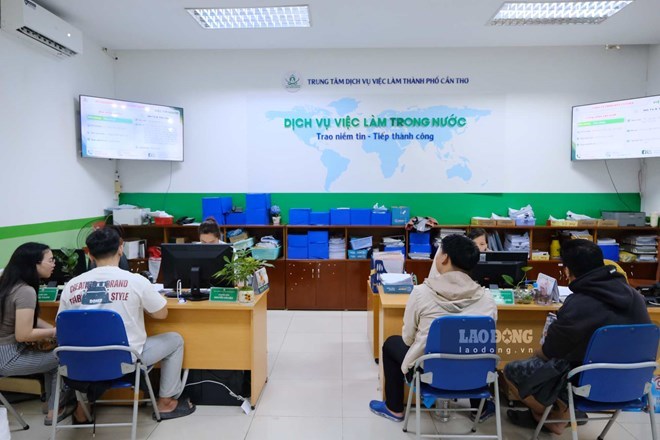
Businesses increase recruitment, young workers still struggle to find jobs
Can Tho - Recruitment demand is increasing, but many young workers still find it difficult to find suitable jobs due to lack of skills and income not meeting expectations.
Trend of job hopping among young people
Although the labor supply in Can Tho City is quite abundant, businesses still face difficulties in recruiting, especially in positions requiring skills. Meanwhile, a part of young workers tends to change jobs when their income does not meet expectations or they do not see development opportunities.
After quitting his job as a waiter at a restaurant, Mr. Nguyen Hai Nam (23 years old, Can Tho City) applied to work as a worker at some production workshops. However, due to lack of formal training and lack of experience, he only worked for 2 months before deciding to switch to another job.
Working hours, living and regulations are all very different from when I was a waiter. Feeling that the job was not suitable, I decided to resign," Mr. Nam shared.
Similarly, Ms. Le Thi My Duyen (25 years old, Can Tho City) said that in nearly half a year, she has transferred to 3 companies. According to her, in general labor positions, in addition to a fixed salary, the opportunity to be promoted to team leader or manager is quite limited if there is no qualification.
After working for a while, I found that the job changed little, it was easy to get bored, so I wanted to find a new environment with a clearer development roadmap," Ms. Duyen said.
Supply-demand mismatch
This year, Phuong Dong Export Food Processing Co., Ltd. (Can Tho City) has recruited about 200 - 300 workers to put into operation a new production workshop.
Ms. Nguyen Huynh Tu Thanh - Vice President of the Company's Trade Union - assessed that recruitment is currently somewhat difficult but not to the point of scarcity. Older workers are often skilled and experienced, while young workers may not have many skills when they first start working.
The main labor source comes from Can Tho and some other localities. For the fish processing sector, some stages require high skills and meticulousness, so recruiting is somewhat more difficult. Young workers when they first start working, if they encounter difficult jobs or specific environments, may develop the psychology of quitting their jobs and moving to another company," Ms. Thanh said.
According to the Can Tho City Employment Service Center, in August 2026, the number of workers consulted for employment increased by 12.82% compared to the previous month; the number of workers introduced for employment increased by 8.56%, but the number of workers supplied to businesses for recruitment decreased by 5.36% compared to July 2026.
Although counseling and job introduction activities have increased, the actual number of workers successfully supplied has decreased due to the structural supply-demand "dismatch".
Recruitment demand in August mainly focuses on general labor directly involved in production and skilled technical workers. Meanwhile, the labor supply is quite abundant but does not meet the professional and technical skills or digital transformation requirements of enterprises.
In addition, a part of workers are not ready to change careers or still have a psychology of reluctance to work far from home, causing even though they are introduced to jobs, the success rate of supply is not high.

According to Master of Public Policy Nguyen Tuan Anh - Saigon Industry Corporation, the current problem is not necessarily that the market no longer has labor, but a fairly clear mismatch is appearing between the jobs businesses need and the jobs young workers want to choose.
Workers at factories often have to work in shifts, with night shifts, comply with production discipline and work in an industrial environment. When placed next to service, sales, delivery or relatively flexible forms of labor in terms of time, work in factories is sometimes less attractive to young people.
See the original here