

Substantive decentralization must go hand in hand with resources
Decentralization and delegation of power are only effective when accompanied by resources, human resources, data and implementation tools, helping to improve the quality of service for people and businesses.
Handing over power must also grant enforcement capacity
Implementing the Resolution of the 14th Party Congress, the requirement for an "institutional revolution" is being concretized by strong steps in decentralization and delegation of power.
Speaking to direct at the preliminary conference on 1 year of operation of the overall organizational model of the political system and the 3-level government model on July 1, General Secretary and President To Lam directed to promote decentralization and delegation of power associated with ensuring resources and controlling power. Decentralization is not about shifting burdens to subordinates but about transferring authority, resources, data, implementation tools and responsibilities in a clear, transparent, and controlled manner.
Conclusion No. 76-KL/TW of the 3rd Conference of the 14th Party Central Committee also emphasized the requirement to improve institutions, promote decentralization and delegation of power associated with resource allocation and power control. Resolutely end the situation of assigning tasks but not ensuring conditions for implementation. The assigned authority must be closely linked to accountability and power control mechanisms.
At the same time, complete the system of standards, regulations, economic - technical norms and sets of measurement criteria for implementation results; strongly shift from management by administrative orders to development management, management by goals, data, output products and the satisfaction level of people and businesses.
Efficiency seen from numbers
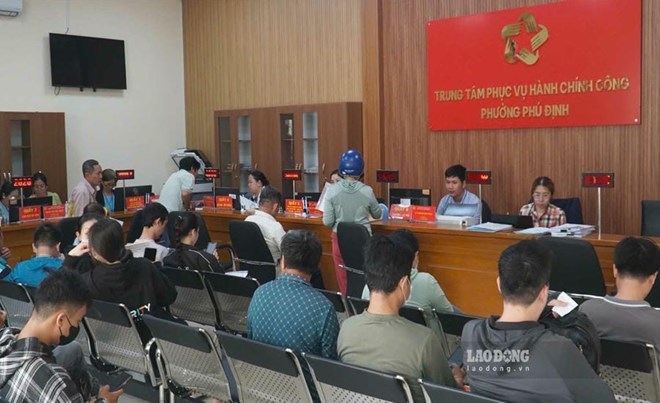
In Ho Chi Minh City, along with promoting decentralization and delegation of power, localities are focusing on improving the implementation capacity of grassroots governments. When more tasks and powers are assigned, the requirements for organizational structure, human resources and work handling capacity at the commune level are also higher.
Currently, Ho Chi Minh City has 900 tasks assigned to departments and branches and 108 tasks assigned to communes in many fields. Many dossiers and administrative procedures (TTHC) are resolved right at the grassroots level, reducing intermediate levels, shortening processing time; and at the same time raising the responsibility of heads and cadres and civil servants in performing public duties.
In Hanoi, the city promotes decentralization and authorization according to the motto "the level that is close to the people, close to the people, and resolves the most effectively is assigned to that level to implement". Hanoi is implementing 661 TTHC authorized from the city and departments and branches down to the grassroots level, creating conditions for people and businesses to resolve work right in the locality. The results show that the efficiency of resolving TTHC has clearly improved. The time to resolve work has been shortened from 3 to 5 days; the rate of dossiers resolved on time and ahead of schedule reached 95.77%.
The effectiveness of the reform process is also reflected in compliance costs. The review and restructuring of administrative procedures has contributed to bringing compliance costs from about 671 billion VND to 263 billion VND, corresponding to a reduction of about 408 billion VND. The city estimates that if this result is maintained, social costs can continue to be reduced by about 1,652 billion VND per year.
In particular, the authorization of many administrative procedures in the fields of land, construction, investment and business registration has contributed to shortening the processing process, reducing compliance costs, improving the investment and business environment and improving people's satisfaction.
To substantially decentralize power between the Central Government, provincial and commune levels, Assoc. Prof. Dr. Tran Thi Dieu Oanh - Head of the Faculty of State and Law (Academy of Public Administration and Management) - said that 4 groups of resources need to be transferred synchronously, including people, finance, data and implementing tools. The allocation of staff and budget should also not be implemented in an average way but should be based on population, volume and complexity of work. Besides material resources, it is necessary to clearly define the scope of localities that are autonomous, self-decided and self-responsible.
Read the original here