
Ho Chi Minh City controls school meals from supply
Ho Chi Minh City expands "Green responsibility tick" into schools, increases traceability, actual inspection and tightens responsibility at each stage.
Control from food sources to meals
In the 2025-2026 school year, school meals in Ho Chi Minh City continuously experienced incidents, from suspicion of using expired food and having to stop semi-boarding to a number of poisoning cases that caused hundreds of students to be hospitalized.
At the end of January 2026, the incident related to An Phuoc Thang SG Trading Co., Ltd. (Sago Food) - a unit providing school meals in Ho Chi Minh City - caused a stir when ingredients suspected of being expired were used to prepare student meals. At the beginning of April 2026, after a semi-boarding meal at Binh Quoi Tay Primary School, out of 740 people using the meal, 266 people were poisoned, 190 people had to be hospitalized. Less than 2 weeks later, Dang Thuy Tram Primary School, Tan Thuan ward, recorded 46 students with suspected poisoning symptoms, of which 29 were treated as inpatients and 17 were monitored as outpatients.
After the incident at Dang Thuy Tram Elementary School, meals provided by the same unit were reviewed at 5 schools, causing many schools to temporarily stop boarding. At times, thousands of Ho Chi Minh City students had to stop eating boarding meals, and parents had to pick up and drop off their children at noon.
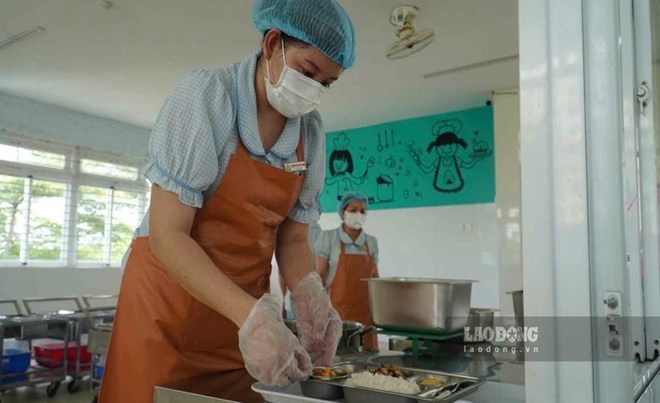
After a series of incidents, Ho Chi Minh City expanded the "Green Stick responsibility" model from controlling goods in general to a safe food chain for kitchens and school meals. The model requires kitchens to comply with food safety regulations, controlling the entire process from importing raw materials, preliminary processing to finished products, thereby increasing transparency for inputs and outputs.
A notable point of the "Responsibility Green Tile" is control from the beginning of the supply chain, linking responsibility from production, transportation to distribution. The model is being implemented in some kindergartens and is expected to expand in the new school year.
Currently, "green tick" is mainly applied to vegetables, meat, and eggs. Through QR codes, parents can check the origin of food from production facilities, preliminary processing, suppliers to schools.
Mr. Nguyen Truong Giang - Vice Chairman of Tan My Ward People's Committee - said that the model has been implemented at Phu My and Tan Phu Kindergartens, helping parents look up menus, nutrition, food origins via QR codes and supporting schools in monitoring the supply chain.
In the coming time, the locality will expand to all public schools, complete traceability data, increase standard suppliers and mobilize non-public schools to participate.
Not only traceability, responsibility must be tightened
From the perspective of market management, Mr. Nguyen Nguyen Phuong - Deputy Director of Ho Chi Minh City Department of Industry and Trade - assessed that the "Responsible Green Tile" program has so far attracted more than 500 businesses, with nearly 6,000 products confirmed. In the context of food insecurity still developing complicatedly, he believes that the formation of a transparent supply chain, enhancing the responsibility of stakeholders from production to distribution is an important solution to protect consumer health.
This is a great opportunity for businesses that do honest business and are responsible to the community," Mr. Phuong emphasized.
However, traceability is only truly effective if it goes hand in hand with actual control and clearly defining the responsibilities of each stage.
According to Ms. Pham Khanh Phong Lan - Director of Ho Chi Minh City Department of Food Safety - in recent years, food safety assurance in schools has been closely coordinated with the education sector and local authorities. This year, this work has been further tightened after the incidents that occurred in the past school year.
To ensure the safety of semi-boarding meals, the Ho Chi Minh City Department of Food Safety continues to clarify the responsibility of the head of the school in selecting partners. Among about 3,500 schools in the area, schools are organizing according to many models, including self-organizing kitchens or ordering meals from professional suppliers.
The Department also continues to provide professional training for principals and more than 4,300 personnel directly in charge of school kitchens. In parallel, it strengthens inspection and penalties when violations are detected, aiming to control 100% of schools in the area.
Read the original here
- 29 communes in Ho Chi Minh City preparing to become wards
- 3 questions the Ho Chi Minh City Party Secretary requests officials to answer when implementing the Law on Urban Development
- Ho Chi Minh City proposes to fine vehicles that do not meet emission standards into the center
- Hanoi parents will have an application to look up and monitor semi-boarding meals