

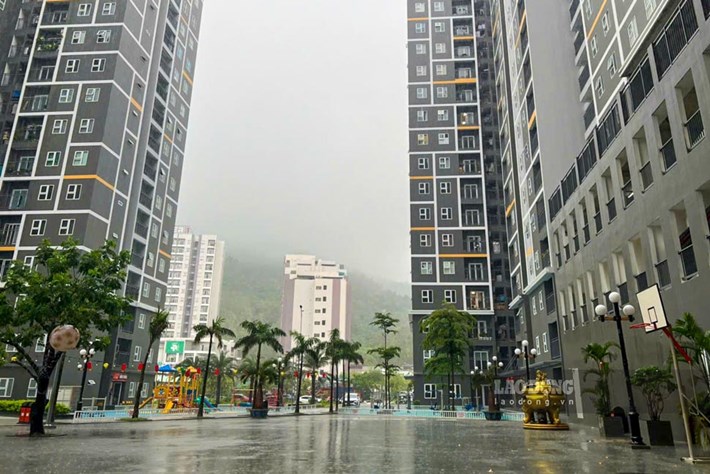
Workers' wages are hard to reach social housing
Gia Lai - Low income, while house prices, interest rates and debt repayment pressure make it difficult for many workers, even if they have demand, to access social housing.
13 years of renting, workers are still far from the dream of settling down
For many workers in Gia Lai, a stable house is still out of reach when the monthly salary has to bear enough expenses.
Ms. Tran Thi Thu Thuy (born in 1985) - a worker at Minh Duong Vietnam Biochemical Co., Ltd. (under the Quy Nhon Dong Ward Trade Union) - said that many worker families have to rent houses and rent rooms for many years. Monthly salaries have to cover food, children's tuition, electricity, water, travel and other living expenses, so it is difficult to accumulate to buy a house.

According to Ms. Thuy, commercial housing prices are too high, while to buy social housing, workers (NLĐ) are still concerned about conditions, selling price, monthly payment amount and ability to borrow capital.
We hope that the social housing policy is not just about having houses to sell, but what is important is that workers have enough ability to buy and rent that house with their own salary," Ms. Thuy expressed.
She hopes that the province will have policies on selling prices, rents, interest rates and loan terms that are more suitable for actual income, so that employees have the ability to repay debts for a long time.
In the same situation of renting a room, Ms. Huynh Thi Dung (born 1992) - a worker at Tan Phuoc Co., Ltd. (Phu Tai Industrial Park) - has lived in a cramped rented room for 13 years.

She worried that when borrowing to buy social housing, after a certain period of time, interest rates will float, no longer having the preferential level as in the early days, while the income of workers is still low.
Ms. Dung also reflected that in reality, there are still cases of social housing being bought and sold through 2-3 hands before reaching workers, causing the purchase price to increase and making it even more difficult to access.
I hope the province will have a policy of borrowing capital with preferential interest rates for a long time, so that low-income workers have conditions to buy social housing with their own salaries," she expressed.
Ms. Dung also proposed to strictly control the purchase and sale and transfer of social housing so that policies reach the right workers with low incomes and housing difficulties.
Social housing must be affordable for workers
To access capital sources, Mr. Nguyen Trieu Quang - Deputy Director of the Gia Lai Provincial Branch of the Vietnam Bank for Social Policies (VBSP) - said that employees who need to borrow capital must register through Savings and Loan Groups at their place of residence or associations and unions. Borrowers need to clearly state their needs, plans and purposes of using capital to serve as a basis for implementing loan procedures.

Mr. Le Anh Tuan - Deputy Director of Gia Lai Provincial Department of Construction - said that social housing is a policy for people with low incomes and housing difficulties. According to regulations, there are 11 groups of subjects eligible to buy or rent-purchase social housing, including workers and laborers.
According to regulations, the income ceiling for registering to buy social housing for single people is a maximum of 25 million VND/month; single people raising children a maximum of 35 million VND/month; cases where married couples have a total income of no more than 50 million VND/month.
Regarding borrowing capital to buy social housing, every year, VBSP bases on the loan amount, repayment amount and income of the buyer to determine the loan interest rate ratio, in order to support employees to access maximum preferential capital sources.

According to Mr. Tuan, currently, the State requires investors to build industrial zones and clusters to plan a certain land area to arrange social housing for workers.
Regarding the selling price of social housing, investors must announce it when the project meets the conditions for opening for sale. According to regulations, the selling price of social housing must be consistent with the income of employees. State management agencies will check the selling price. If the actual selling price is found to be higher than the announced level, investors must be responsible and return the difference to employees who have placed orders.
The State uses post-inspection tools to ensure that workers buy at the right price, without having to spend any extra money for the social housing apartment they have bought," Mr. Tuan said.
See the original here


