

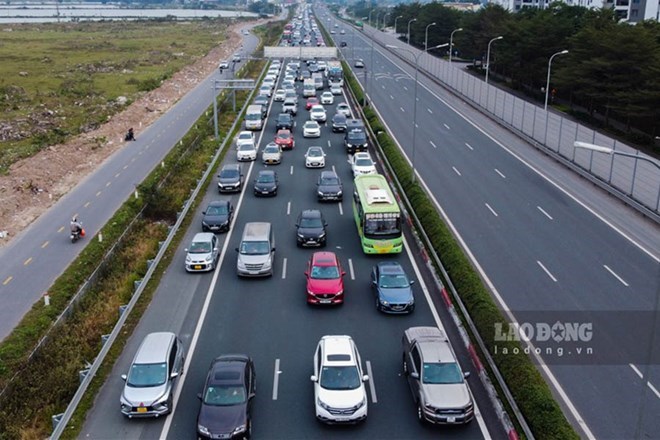
Fines for vehicles not keeping a safe distance on the highway: Strengthening the application of surveillance cameras
When the expressway is congested or an incident occurs in front, drivers traveling below 60km/h must proactively maintain a distance appropriate to the traffic situation.
Determine a safe distance when congestion occurs
Keeping a safe distance is one of the important requirements for vehicle operators on highways, especially when the traffic speed is high. However, when vehicle traffic increases or congestion occurs, many drivers are still wondering how to maintain the distance to be both in accordance with regulations and ensure safety.
According to the Traffic Police Department (CSGT) of the Ministry of Public Security, in conditions where the road surface is dry, without fog, the road surface is not slippery, the terrain is flat, the road is straight and visibility is guaranteed, the safe distance is determined corresponding to the vehicle speed.
When the speed is 60km/h, the minimum safe distance is 35m; over 60km/h to 80km/h is 55m; over 80km/h to 100km/h is 70m; over 100km/h to 120km/h is 100m.
However, in case of increased vehicle traffic or congestion due to an incident in front, the regulation does not require vehicle drivers running below 60km/h to maintain a fixed distance.
Accordingly, drivers running at speeds below 60km/h must proactively maintain a safe distance suitable for vehicles running in front. This distance depends on the density of vehicles and the actual traffic situation to ensure traffic safety.
This means that when the traffic flow on the expressway is congested, causing the car speed to drop below 60km/h, drivers need to proactively adjust the distance with the car in front according to vehicle density and traffic conditions, instead of rigidly applying a certain level of distance.
The Traffic Police Department also noted that when it rains, there is fog, the road surface is slippery, the road has winding terrain, steep passes or limited visibility, drivers must adjust the safe distance greater than the value recorded on the sign or the value specified in favorable weather conditions.
Strengthening control of behavior of not keeping distance
According to the Traffic Police Department, at a speed of 100 km/h, each second the car moves about 28m. With a distance of 100m, drivers only have about 3.6 seconds to detect, react and handle situations.
Statistics from the Traffic Police Department show that more than 30% of the total number of serious traffic accidents on highways originate directly from causes related to keeping distance, leading to mass car accidents.
Therefore, the Traffic Police Department determines that to prevent accidents, it is necessary to strictly comply with regulations on keeping safe distances on highways, even when the risk has not turned into consequences.
The Traffic Police Department believes that keeping a safe distance is not a regulation to "make things difficult" for drivers, but to create a safety habit, helping to protect themselves, their families and the community.
In the coming time, the traffic police force will maximize the application of smart surveillance camera systems and professional technical equipment to focus on controlling, remote fines as well as direct handling of violations.
The Traffic Police Department recommends that vehicle drivers actively control their speed, observe distance signs and maintain the correct prescribed distance when participating in traffic on the expressway.
Read the original here