
Workers need vocational training to keep jobs in the digital age
Faced with the wave of automation, workers want to learn and improve their skills to retain work, increase income and adapt to new requirements.
Young workers hope to have the opportunity to learn a trade
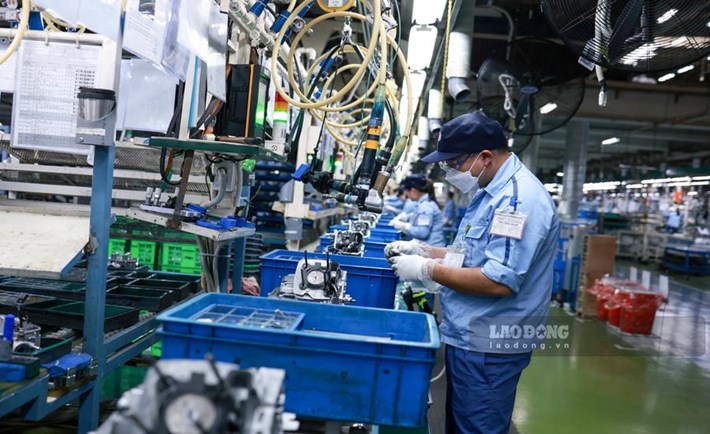
Nguyen Si Hiep (from Thanh Hoa), a worker at an electronic component assembly company in Thang Long Industrial Park (Hanoi), just left his hometown to work in Hanoi. This is the first time Hiep has been away from his family, so everything is still very unfamiliar.
Studying one year later than his friends, this year Hiep just completed his high school program. Instead of continuing to study further, the male worker chose to work to have a stable income, save some money and later consider vocational training.
Currently, Hiep works the night shift from 10 pm to 6 am the next morning. During the shift, workers have one hour of rest and the company arranges night meals. Hiep's basic salary is about 6.3 million VND/month. If he does extra work, his income can reach nearly 10 million VND/month.
In a foreign land, I just hope for stable jobs and health to work. Later, if I have the conditions, I want to learn more and improve my skills so that I can stick with the job for a long time and have the opportunity to increase my income" - Hiep shared.
However, the young male worker's desire to learn a trade is still accompanied by many worries. Shift work, overtime, and costs of renting accommodation, food, and travel make it difficult to arrange time and expenses to participate in a course.
Hiep hopes that vocational training programs will have short-term courses, flexible times, suitable for workers' work schedules. In particular, out-of-province workers like Hiep need to be supported with a part of their tuition fees so that they can boldly improve their qualifications.
Converting unskilled labor into skilled labor
At the age of 26, Mr. Tran Van Minh, a worker working at a hard drive component company in Thang Long Industrial Park, has been attached to the factory for several years. The main job is to stand on the line, inspect, and package products in stages. Although familiar with the job and having a relatively stable income, Mr. Minh admitted that if you only rely on your current labor and experience, long-term development opportunities are limited.
“We general workers are the ones who directly stand the machine, make products, but when businesses change technology, we are also the group that is easily affected. If machines can do the jobs they are doing, workers must have other skills to continue to stay” - Mr. Minh said.
According to Mr. Minh, a part of unskilled workers still have the mentality of "doing it day by day". The pressure of rent, living expenses, raising children or sending money home makes them prioritize overtime to increase immediate income rather than spending time studying.
“Want to learn a trade, but if studying in the evening, it is overlapping shifts or overtime. Taking a break from work to go to school also means reducing income. If businesses and trade unions can organize courses right in the industrial park, at a time suitable for the working shift, or have tuition fee support policies, workers will be easier to participate” - Mr. Minh proposed.
In fact, besides professional limitations, a part of unskilled labor still lacks industrial style, basic digital skills and adaptability to an increasingly modern production environment. These are barriers that need to be recognized in the process of improving the quality of human resources.
For workers, vocational training is not only aimed at getting a certificate, but more importantly, to have more capacity to retain work, change positions when technology changes and gradually increase income.
See the original here