
Releasing resources for sustainable growth
Vietnam's economy maintains positive growth momentum but still faces many bottlenecks. In that context, the Government requests acceleration, breakthrough, and focus on removing obstacles in public investment, institutions, capital and markets, thereby unlocking resources and creating more motivation for businesses in the last months of the year.
Unlock key resources to promote growth targets
2026 is the first year of implementing the 5-year socio-economic development plan 2026-2030, opening a new development phase with higher requirements for growth rate, productivity, quality and competitiveness. Many economic indicators recorded notable increases. State budget revenue in 8 months reached 2.03 million billion VND (equal to 80% of the estimate). Import and export in 8 months reached 770.14 billion USD, an increase of 28.7%.
Many international organizations continue to positively and optimistically assess the economic situation in Vietnam and forecast that Vietnam in 2026 will be among the leading high-growth countries in the region and the world; in August, the IMF raised our country's 2026 growth forecast to 8.2%, an increase of 1.1% from 7.1% (April 2026).
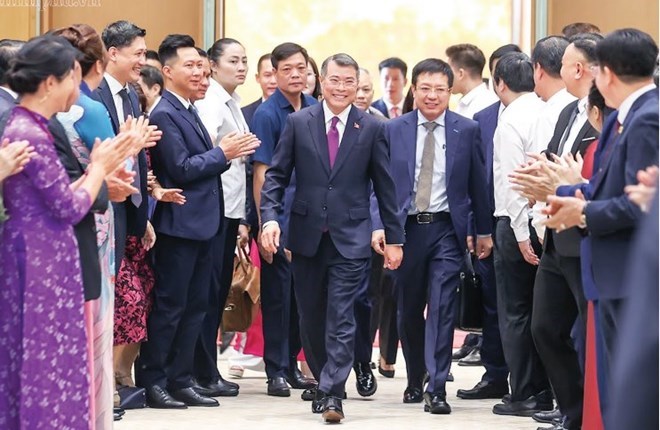
At the regular Government meeting in August 2026, Politburo Member, Prime Minister Le Minh Hung requested ministries, agencies, and localities to regularly review and update growth scenarios monthly and quarterly; proactively identify bottlenecks affecting growth targets to focus on removing them, especially sectors and localities that are driving forces and still have great growth potential, with the highest determination to achieve the set goals.
This is a requirement of direct significance to the business environment. When growth is closely monitored monthly and quarterly, bottlenecks in institutions, capital, land, materials, markets or procedures need to be handled in a more specific direction, instead of being extended to subsequent periods.
The goal of double-digit growth in the coming period requires a fundamental shift in thinking and operating methods: from "stable for development" to "stable for breakthrough"; from "improving the business environment" to "creating national competitive advantage"; from "supporting businesses" to "empowering, creating conditions and leading" businesses to become the main force of growth.
The focus is not only on removing immediate difficulties, but also on synchronously unlocking resources in capital, land, infrastructure, technology, human resources and markets; and at the same time forming a substantive linkage ecosystem between state-owned enterprises, private enterprises and FDI enterprises.
The Ministry of Finance is assigned to strengthen urging, promoting, and accelerating the disbursement of public investment capital, ensuring the completion of 100% of the assigned plan; actively and effectively implement solutions to develop capital markets, corporate bonds, and securities to supplement resources for growth and reduce dependence on credit capital.
In particular, reviewing, accurately classifying and thoroughly handling backlog projects is an urgent requirement to unlock resources and create momentum for economic growth. By the end of August 2026, 2,684/4,899 backlog projects had been thoroughly handled, with a total area of over 102,000ha and a total investment of over 2 million billion VND.
Thus, a very large volume of land and resource projects has been put into operation, contributing to promoting and supporting growth, especially supporting localities in budget collection as well as releasing resources that have been backlog for many years.
Solving major problems in mobilizing and using resources effectively
Along with promoting growth, the requirement to control inflation and manage prices is still placed in parallel. The State Bank is required to manage monetary policy proactively and flexibly, directing credit to priority sectors and key projects, and at the same time balancing between controlling inflation and supporting growth, striving to reduce lending interest rates.
For businesses, access to capital and cost of capital are one of the factors determining production expansion capacity. Therefore, directing credit management associated with priority sectors can create more room for projects that are likely to contribute to growth.
Regarding finance, the Ministry of Finance is required to continue to implement policies on tax and fee exemptions, reductions, and extensions; and at the same time accelerate value-added tax refunds for businesses that well comply with the law through risk classification. These are solutions that directly affect the cash flow and costs of businesses.
At the beginning of September 2026, the Government will hold a meeting to contribute opinions to the draft Law on Land (amended), Law on Housing (amended) and Law on Real Estate Business (amended) which are closely related and play a very important role in unlocking resources, meeting the requirements of growth in the coming time; contents that have a great impact on people, organizations, investors, the economy, security, and defense.
With similar binding nature are 4 draft laws including: the Law amending and supplementing a number of articles of the Investment Law, the Bidding Law (amended), the Law on Consolidated State Budget, and the Law on Small and Medium Enterprise Development. These 4 draft laws have a close relationship, interact and aim together for a common goal of truly removing bottlenecks, contributing to completing the legal corridor, unlocking resources, creating new development space and room, contributing to the implementation of the goal of double-digit growth and sustainable development.
This is not a technical correction, correcting individual issues, but must solve major, fundamental problems, bottlenecks that are hindering the mobilization, allocation and effective use of development resources.
Another general requirement emphasized by the Prime Minister is that the articles and contents of laws must be clear and transparent to unify the understanding and implementation. It is necessary to collect broad and substantive opinions, accompanied by policy explanations for people, businesses and related parties to understand correctly, so as not to have different understandings. Regulations on handling transitional issues must be very specific, avoiding legal loopholes when implementing; proactively prepare synchronously, and at the same time detailed regulations and conditions to ensure implementation.
Converting resources into investment, jobs, and products
Talking to Lao Dong Newspaper, National Assembly Deputy Pham Van Hoa (Delegation of National Assembly Deputies of Dong Thap) said that in the journey towards the double-digit growth target, creating new driving forces is an inevitable requirement, but unlocking existing resources that are being blocked is also a growth potential that needs to be utilized. When land is put into use, capital flows are unlocked and eligible projects are continued to be implemented, those resources can be transformed into investment, jobs, products, creating momentum for the country's economy to grow. In which, digital transformation, if done well, can contribute an additional 1-1.2% of GDP/year. Institutional reform, especially cutting down administrative procedures and unlocking resources, can contribute an additional 0.8-1% of GDP. Economic locomotives also have a large potential. If each locomotive breaks through further, the whole country will grow rapidly.
Read the original here