

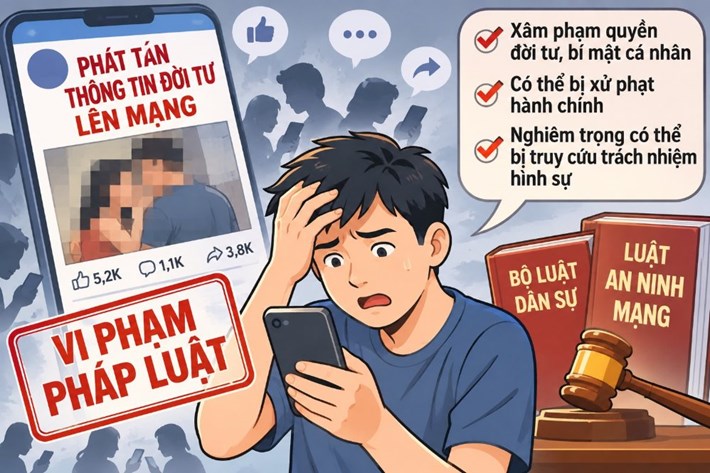
Looking at the case of catching a jealous woman in a car in Ho Chi Minh City: What is the line for the outrage of the crowd?
In recent days, the case of catching jealousy in a car in Tan An Hoi commune (HCMC) has become the focus of image sharing and endless discussion in cyberspace.
Catching jealousy is not new, but what is alarming is the way many people nonchalantly share, edit, judge and "hunt" for the identity of the person involved without hesitation....
Sharing with Lao Dong Newspaper, sociologist - Master Nguyen Duy Hai (Van Hien University) frankly asked: "Are we protecting morality, or are we violating the law in a collective excitement without knowing it?
When crowds "join hands to prosecute" online
According to MSc. Nguyen Duy Hai, the nonchalant sharing of private clips stems from the phenomenon of "moral disengagement". Hiding behind screens and crowds, users reassure themselves that they are "just in the name of the truth" to legitimize an act of infringing and violating the law.
Outrage over disloyalty in love and marriage is a completely justified moral emotion. However, M.A. Nguyen Duy Hai emphasized that the boundaries need to be clearly distinguished: moral outrage is an individual right, while arbitrarily disseminating private images of others is an act of violating the law, regardless of whether the other person is wrong or not.
Vietnamese law protects the right to image and privacy independently, regardless of the moral standing of the parties. Specifically, Articles 32 and 38 of the 2015 Civil Code affirm that privacy and personal secrets are inviolable. Most recently, the 2025 Network Security Law (No. 116/2025/QH15) and Decree 330/2026/ND-CP (effective from August 19, 2026) have clearly stipulated: the act of disseminating information and images that infringe on privacy illegally may be administratively sanctioned from 10 to 20 million VND, or criminally prosecuted.

Even people who make ethical mistakes still have privacy protected by law. This is not a paradox, but the core foundation of a rule-of-law state. However, the "public court" is giving itself the right to punish: no procedures, no presumption of innocence and no opportunity to appeal. That is not justice, but collective violence disguised in ethical language.
Turning other people's pain into view-baiting
The most worrying thing is not emotional anger, but the fact that a series of accounts are calmly cutting and pasting, teasing headlines to commercialize harm to others in the "attention economy". The algorithm is not ethical; it only prioritizes content that makes the crowd stop for the longest time.
From a clinical psychological perspective, victims suffer two levels of trauma: trauma from the original event and trauma when exposed to millions of strange eyes. International studies confirm that this behavior causes post-traumatic stress disorder (PTSD), severe panic attacks and directly increases suicidal thoughts.
Looking from the sociological theory of Émile Durkheim (Le Suicide, 1897), being "exposed" virally deprives an individual of their social status almost instantaneously, pushing them into the risk of "egoist suicide". That is the price of mental health, sometimes even life, that the victim has to pay, while the crowd has rushed to the next topic.
Loopholes that need to be frankly acknowledged
MSc. Nguyen Duy Hai said that the incident in Tan An Hoi commune is not an isolated case but a repeated warning bell about three major loopholes that have not been filled.
The first is the neglect in digital behavior education. Although the culture of communication in real life is taught thoroughly, the content about online ethics and privacy is almost vacant. Many people, especially young people, completely freely share private clips without knowing that an unconscious button can lead to administrative sanctions or criminal prosecution.
Second is the gap in law enforcement. Current sanctions, although there are, have not been applied consistently and publicly. When violations are not handled thoroughly, society will inadvertently consider them to be tolerated behavior.
Third is the relaxed responsibility of digital platforms. Social networks cannot stand aside or continue to indulge in violating content using views distribution algorithms. It is necessary to force platforms to have mechanisms to remove violating information quickly, transparently and be responsible for serious accountability before the law.
Indignation at wrongdoing is a natural emotion, but invading other people's privacy is crossing the line of civilization. Before'sharing' a private clip, ask yourself: "If the person in it is me, do I want this to happen?" If the answer is no, please stop" - M.A. Nguyen Duy Hai sent a message.
This is not just the story of a jealous arrest. This is a story about how we want to build a digital space, a space where human dignity is respected even when a person makes a mistake. The answer to that question comes not only from the law or functional agencies alone, but also from each small choice of each network user, every day...
See the original here