

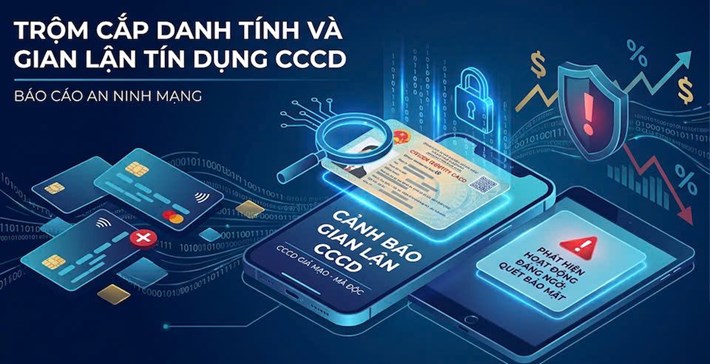
Being impersonated with a CCCD to borrow money, does the victim have to repay the debt?
Thieves use fake CCCD to carry other people's information to borrow credit money, causing victims to bear unjust debts. Lawyers analyze legal responsibility and handling methods.
Facing severe punishment, fake contract invalidated
Talking to Lao Dong Newspaper, lawyer Truong Thi Kim Thy (Ho Chi Minh City Bar Association) said that the act of forging CCCD, using identification information of others to borrow money or buy goods in installments can constitute many crimes under the Penal Code, depending on the trick and value of embezzled assets.
Specifically, the act of forging and using fake personal identification papers may be prosecuted for the crime of forging seals and documents of agencies and organizations; the crime of using fake seals or documents of agencies and organizations with the highest prison sentence that can be up to 7 years in prison. On the other hand, people who forge ID cards/CCCD also have the purpose of using these fake papers to sign loan contracts, buy goods in installments, so the subject may also be prosecuted for the crime of fraudulent appropriation of property with the highest penalty of life imprisonment if this person uses fake papers to deceive appraisal staff or sellers in order to appropriate money and property worth 02 million VND or more, or less than 02 million VND but under the law.

For the act of collecting, buying, selling, and illegally using personal information in cyberspace for the purpose of appropriating other people's property, it may also be prosecuted for the crime of using computer networks, telecommunications networks, and electronic means to commit acts of appropriating property under Article 290 of the Penal Code with the highest penalty of 20 years in prison.
According to the Law on Anti-Money Laundering, financial companies are responsible for recognizing customers and comparing and verifying identification information with the national population database. However, with the need to quickly disburse money to customers when borrowing money in just a few minutes, the appraisal may not be guaranteed in terms of checking the forgery of personal information. Financial companies need to pay attention to the review and close coordination with the VNeID system to verify customer information, ensure legitimate rights and prevent risks for businesses and people themselves.
Regarding the debt arising from being impersonated, lawyer Kim Thy said that according to the provisions of the 2015 Civil Code, transactions with fraudulent elements are defined as invalid transactions. In case people do not participate in establishing contracts, do not sign or authorize borrowing money, they cannot be automatically forced to repay the debt. Therefore, people are not obliged to pay the above debt.
People who are impersonated need to quickly send complaints to credit institutions, request to provide loan documents, disbursement documents and coordinate with the police agency to verify. When there is evidence to determine that they are not borrowers, credit institutions need to handle the debt, adjust CIC credit information according to the verification results and legal regulations. The amount of money appropriated must be requested to be recovered from the fraudulent perpetrator," lawyer Truong Thi Kim Thy recommended.
How to handle wrongful debt collection and 5 principles of information protection
When suddenly being requested by financial units to pay a loan not made by themselves, people should not rush to admit the obligation to repay the debt or transfer money. According to lawyer Truong Thi Kim Thy, people who are impersonated should proactively request debt collection units to provide loan contracts, identification documents and disbursement documents for comparison, and send written complaints requesting transaction verification.
During this process, people should keep evidence such as recording calls, messages, screenshots of debt collection content and related notices. In case there are signs of using fake papers to appropriate property, it is necessary to report to the police agency for verification and handling.
To limit the risk of information being stolen and impersonating borrowers, lawyer Truong Thi Kim Thy recommends that people implement the following 5 security principles:
First, do not arbitrarily share personal papers: Do not publicly post or send double-sided images of CCCD, driver's licenses, bank cards on social networks and unsafe messaging applications.
Second, be wary of strange links and authentication requests: Do not provide OTP codes, identification information or facial images for links of unclear origin, even when required to update biometrics or receive rewards.
Third, strictly manage CCCD copies: Do not hand over the original to an uncompetent establishment. When providing a copy for a specific transaction, the purpose of use should be clearly stated on the copy to limit the risk of being used for the wrong purpose.
Fourth, be cautious when using AI applications: Limit uploading portrait photos, facial images and personal data to applications of unclear origin that have not been verified for security policies.
Fifth, periodically check credit history: People can register an account at the official information portal cic. gov. vn to look up credit information, promptly detect unusual loans and request verification when detecting signs of being impersonated.
See the original here