

Borrowing 20 million VND, actually receiving 16 million: Trap from leaflets for lending money
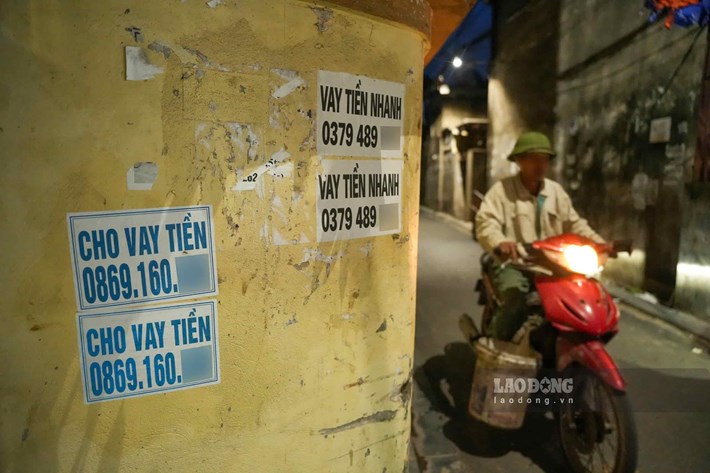
Many "loan money" advertisements appear on power poles and walls in boarding houses and crowded workers' alleys in Hanoi.
Behind the invitation to quickly lend, simple procedures are interest and debt recovery methods that can push workers into a spiral of debt.
In many alleys in Bau village, Thien Loc commune (Hanoi City) - a place where many workers rent rooms, it is not difficult to see papers printed with phone numbers and the words "lending money" pasted on walls and electric poles.
Small advertisements, without stating the name of the organization or specific transaction address, but easily reach people who need to borrow capital, especially migrant workers with limited incomes.
In the role of people who need to borrow money, we contacted the phone number 0379489xxx to learn about the form and procedures for borrowing.
The man at the other end of the line continuously asked about his address, hometown, current job, amount of money he wanted to borrow and purpose of use. To complete the procedures, this person requested to provide some personal papers such as citizen identification card, driver's license.
When we introduced ourselves as working as workers at a company in Thang Long Industrial Park (Hanoi), having a need to borrow money to import clothes for online sale, the man continued to ask: "So do you have any clothes at home?
After knowing that we had never traded in this item, the lender said he did not provide support in the above form, and suggested that we could borrow by mortgaging vehicle documents. The condition was that vehicle documents must be owned by the owner.
This person continued to ask about the brand and year of manufacture of the vehicle. When we provided information about the Honda Air Blade car, manufactured and registered in 2025, the lender immediately offered a specific loan amount.
Now borrowing 20 million VND, I receive 16 million VND, the interest is 80,000 VND/day" - the man said.
According to the calculation given by this person, the borrower must pay 400,000 VND/day, including principal and interest, continuously for 50 days. Thus, the total amount to be paid is 20 million VND, while the actual amount received is only 16 million VND.
When we asked about the case of not being able to repay on time, the man said: "We only lend for 50 days, and overdue is a rare case.
Information about the loan, the actual amount received, the repayment term and how to handle it when it is overdue are all exchanged via telephone. People who need to borrow almost have to consider themselves, while the terms related to the loan have not been clarified in writing.
Not only appearing on the streets, loan invitations also creep into boarding house areas, where many workers and migrant workers are concentrated.

Ms. Ban Thi Thom - a construction worker renting a room in Bau village, Thien Loc commune - said that she often sees money loan advertisements posted in densely populated areas.
Having just come to Hanoi to work for a few months, Ms. Thom is still very unfamiliar with life in the city. Previously, her family used to borrow capital in the countryside under the category of poor households with preferential interest rates. Therefore, she understands the value of loans with clear origins, conditions and specific interest rates.
Currently, she works in construction with an income of more than 300,000 VND/day. Due to food and accommodation support, she can save a sum, without having to borrow.
What Ms. Thom is worried about is that the forms of lending are unclear and have high interest rates. She believes that when life becomes difficult and workers urgently need money, they can easily lose their composure, not carefully understand the loan conditions and rush to receive money. When they are not able to repay the debt, the initial loan may become a long-term burden.
According to Ms. Thom, each worker should try to have a provision for savings. In case they really need to borrow money, they need to carefully research information, choose reputable banks or credit institutions, and avoid borrowing according to unclear advertisements.
In fact, for workers with modest incomes, a seemingly small loan amount can lead to great debt repayment pressure if they do not clearly understand interest rates and terms.
The invitations to borrow quickly and receive money easily therefore need to be viewed more cautiously, especially in areas with a large concentration of workers and tenants.
See the original here