

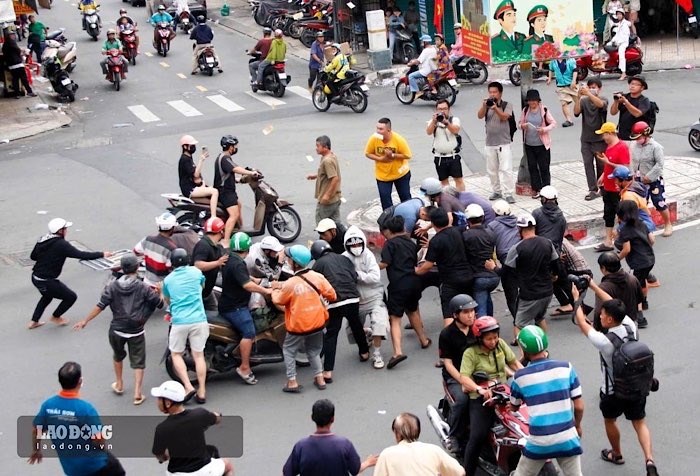
Losing control of a lost soul, beware of being involved in robbery
Ho Chi Minh City - Overcoming the limit when snatching a ghost easily makes the snatcher entangled in legal trouble.
In July of the lunar calendar every year, people often have the custom of worshiping sentient beings (ghost worshiping). Accompanying the ghost worshiping custom is the custom of snatching ghosts arising as a natural consequence after the worshiping ceremony.
From a legal perspective, the act of snatching an uncontrolled wandering soul can be criminally prosecuted or administratively sanctioned.
Regarding this issue, in an exchange with Lao Dong Newspaper, Lawyer Duong Viet Co (Ho Chi Minh City Bar Association) said that the custom of snatching wandering souls allows outsiders to take money and offerings after the homeowner has completed the ritual and agreed to let everyone take them. However, if they arbitrarily rush in to take things when the homeowner does not agree, destroy property, cause injury or use force to take things, this act has exceeded the scope of the custom and may entail legal liability.
In the first case, the homeowner proactively spreads money or throws offerings outside after completing the ritual.
From the perspective of civil law, according to Lawyer Duong Viet Co, the homeowner's proactive disposal of property in this case shows the will to give up ownership of that property.
Therefore, those around pick up or compete for the money and offerings that the homeowner has proactively scattered, in principle, are not considered acts of theft, robbery or robbery.
However, if people participating in snatching wandering souls gather in large numbers, causing chaos, and disrupting security and order, they may still be administratively fined from 2-3 million VND according to Point b, Clause 2, Article 8 of Decree 282/2025.
In case the act of causing disorder is serious, the violator may even be prosecuted for criminal liability for the crime of disturbing public order.
The second case that may occur is those who participate in waiting but intentionally rush to snatch offerings when the homeowner has not finished worshiping or has not allowed them to be taken.
According to Lawyer Duong Viet Co, in this case, although the money and offerings on the offering tray are prepared by the homeowner for the purpose of giving away, but when the homeowner has not finished the offering ritual and has not clearly expressed the will to give away, the ownership of this property still belongs to the homeowner.
Therefore, the act of publicly and quickly snatching property without the homeowner's permission shows signs of the crime of robbery, as prescribed in Article 171 of the Penal Code.
Article 171. Robbery of property
Anyone who robs other people's property shall be sentenced to imprisonment from 01 year to 05 years.
Committing a crime in one of the following cases shall be sentenced to imprisonment from 03 years to 10 years: Organized; Assault to escape; Causing adverse effects on security, order, social safety...
Committing a crime in one of the following cases shall be sentenced to imprisonment from 07 years to 15 years: Appropriating property worth from 200 to less than 500 million VND; Causing injury to others from 31% to 60%...
Committing a crime in one of the following cases shall be sentenced to imprisonment from 12-20 years or life imprisonment: Appropriating property worth 500 million VND or more; Causing death.
In addition, offenders may also be fined from 10-100 million VND.
See the original here