


Salary reform roadmap and expected 5 new salary scales in 2027
In March 2027, the Central Government will submit a project to reform salaries and social insurance, expected to have 5 salary scales and 9 new allowance regimes.
The Central Steering Committee for salary policy reform, social insurance (BHXH) and preferential treatment for people with meritorious services has issued Decision 124/QD-BCĐCCTLBHXH on the plan to study and develop a Project on salary policy reform and social insurance to submit to the 5th Conference of the 14th Party Central Committee.
Accordingly, ministries, branches, and relevant agencies will conduct a summary and assessment of the implementation of salary and social insurance policies since the Central Government issued Resolution No. 27-NQ/TW, Resolution No. 28-NQ/TW (in 2018) to date, clearly stating the inadequacies, analyzing the causes and proposing specific recommendations on the specific characteristics of ministries and branches.
Regarding salary policies, including the minimum wage (base salary), salary scale, salary allowance regimes, salary mechanisms for subjects under the management sector and sent to the Ministry of Home Affairs (Standing Committee of the Steering Committee) for synthesis.
According to the plan, from October-August 2026, the Ministry of Home Affairs and members of the Steering Committee will develop and complete the draft project. In January 2027, complete the draft Resolution. In February 2027, submit it to the Politburo, the Secretariat and in March 2027, submit it to the 14th Party Central Committee.
Thus, 2027 is expected to be identified as an important milestone in the salary reform roadmap. Based on the spirit of Resolution 27-NQ/TW, the new salary system will be built based on job positions, while adjusting the regional minimum wage to ensure the lives of workers in both the public and private sectors.
The Ministry of Home Affairs is currently coordinating with specialized agencies to research and complete a plan to build 5 new salary scales. The new point of this system is to replace the old salary calculation method with a salary structure based on job positions and leadership titles.
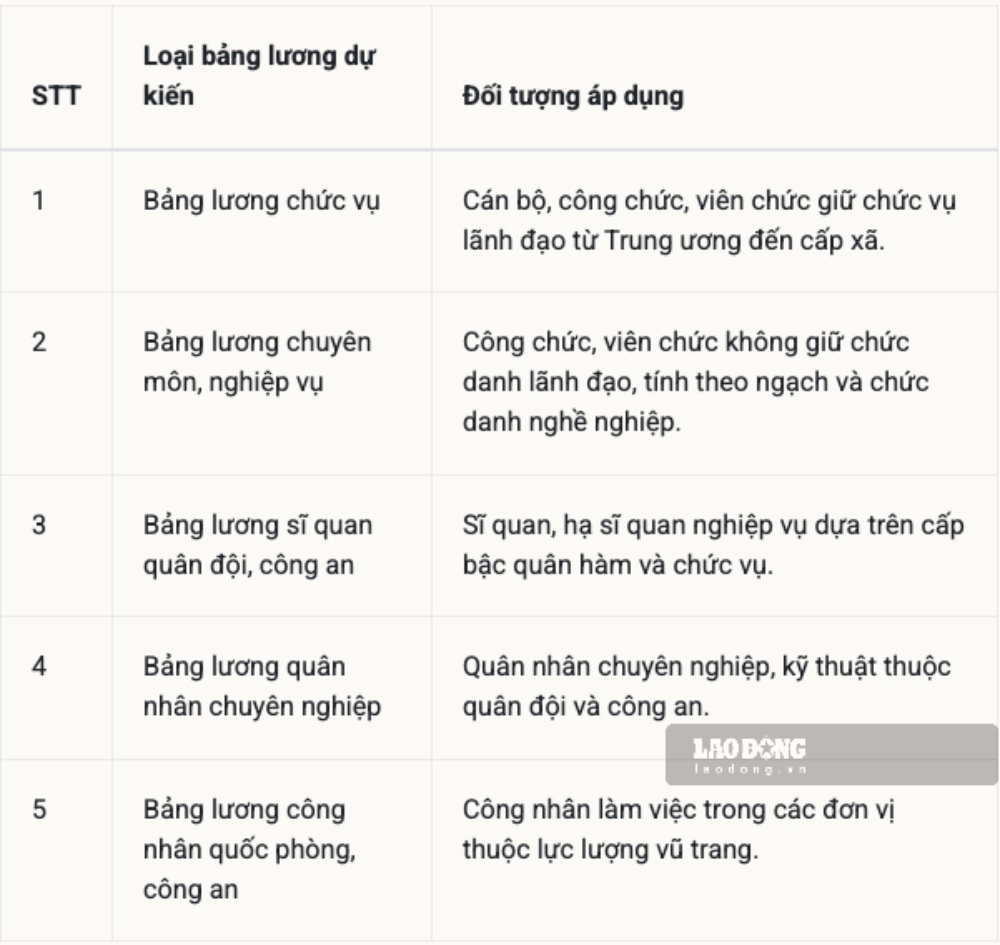
It is expected that there will be 9 types of allowances applied, including: concurrent position allowances, seniority allowances exceeding the frame, area, work responsibility, mobile, professional allowances, regional allowances for particularly difficult areas, allowances according to administrative/business unit classification and special allowances for the armed forces.
The time of official application of the salary scale according to job positions will depend on the decision of the competent authority after considering the preliminary review report of Resolution 27-NQ/TW.
Previously, on June 21, 2024, the Politburo issued Conclusion No. 83-KL/TW on salary reform; adjusting pensions, social insurance allowances, preferential allowances for people with meritorious services and social allowances.
In addition to spending on salary reform, the Politburo agreed to report to the Central Party Committee on expanding the scope of using accumulated sources of salary policy reform from the central and local budgets to spend on adjusting pensions, social insurance allowances, preferential allowances for people with meritorious services, social allowances, social security policies and streamlining staff.
Read the original here