
When experience is no longer an advantage for middle-aged workers
40-year-old workers are considered to be experienced in facing the risk of reduction due to slow updating of technology skills and being passive to new production tools.
Great competitive pressure
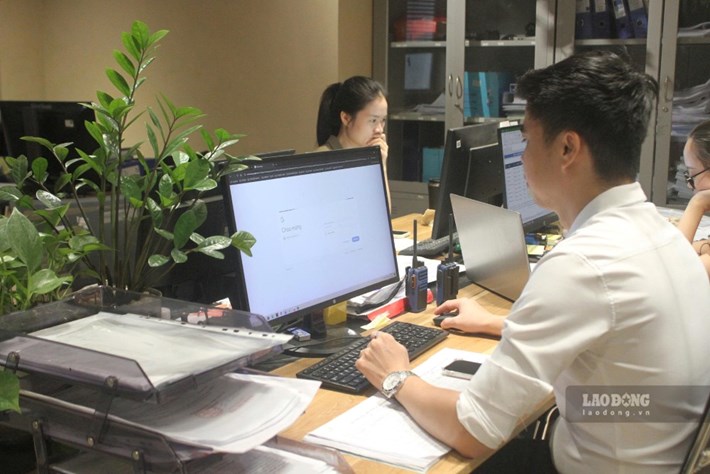
Ms. Vu Thu Hang, 44 years old (Thanh Xuan ward, Hanoi City) is currently the head of the business department of a building exploitation and operation unit. Before taking on the current position, Ms. Hang used to work in many different fields. According to her, each job brings her own experiences and knowledge, helping her accumulate skills to adapt to the new requirements of the labor market.
After many years of working, Ms. Hang decided to choose her current job because she has a more stable time fund, helping to balance work and family life. However, after turning 40, Ms. Hang is even more aware of the competitive pressure in the labor market.
According to Ms. Hang, in the context that businesses are increasingly prioritizing technology and young labor force, middle-aged workers, if they only rely on experience, it will be very difficult to create an advantage.
The current labor market is very fiercely competitive. In my opinion, just accumulated experience and knowledge is not enough, the important thing is to prove the value you bring to the business," Ms. Hang shared.
Clearly aware of this, the female manager said that she always proactively updates new knowledge to meet work requirements. In addition to improving her expertise, Ms. Hang spends time learning about new technology trends, especially artificial intelligence (AI), and also participates in short-term courses to improve professional skills and management skills.
According to Ms. Hang, studying at the age of 40 does not necessarily require returning to school, but can be flexible through online courses or in-depth training programs suitable for each job position.
I myself still have to upgrade myself every day. I often participate in online courses to supplement knowledge and update necessary skills, helping work achieve better efficiency," Ms. Hang said.
Not only investing in expertise, Ms. Hang also believes that middle-aged workers need to soon prepare a financial foundation to proactively respond to risks such as job loss, illness or income decline.

At this age, I still can't stop studying. The more proactively I improve my skills and prepare for the future as soon as possible, the more pressure I will reduce before the changes of the labor market," Ms. Hang expressed.
Proactively improving skills is the "key" to help middle-aged workers "stay" in the labor market
Mr. Le Quang Trung - former Deputy Director in charge of the Department of Employment - said that workers aged 40-45 are a group that has matured in work, knowledge, and skills; many people hold important positions in businesses.
However, due to the too rapid transformation of science and technology, AI..., current workers are forced to meet the requirements of science, technology, and engineering. Meanwhile, a significant part of the 40-45 age group has not been trained, or even if trained, it does not meet the current requirements, so the possibility of job loss is very high.
Regarding solutions, Mr. Trung said that workers in the 40-45 age group must have early preparation awareness, be proactive in training, and accumulate experience right in the working process, even from the age of 30-35. In addition, it is necessary to grasp labor market information and improve their ability to adapt to the requirements of the new working environment.
Businesses need to have training plans to retain the group of workers aged 40-45 to take advantage of the experience and skills they have accumulated for decades.
Training institutions must focus on training in industries and fields that are forecast to be labor-intensive in the coming time. On the State's side, it is necessary to have policies to support this age group of 40-45 in training and fostering; and at the same time orient businesses to create jobs to attract this labor group.
Looking broadly, the labor market needs medium and long-term forecasts so that businesses, workers, and training institutions have orientations in training because many fields can be trained immediately, many fields require a process. The labor market also needs a close relationship between businesses and training institutions, engineers become teachers, workshops become classrooms. This connection will meet current reality" - Mr. Le Quang Trung affirmed.
See the original here