
Workers need to actively study throughout their lives to master technology
Workers need to proactively study throughout their lives, improve digital skills and adaptability to master technology, meeting the requirements of businesses.
Businesses need workers who know how to apply technology in practice
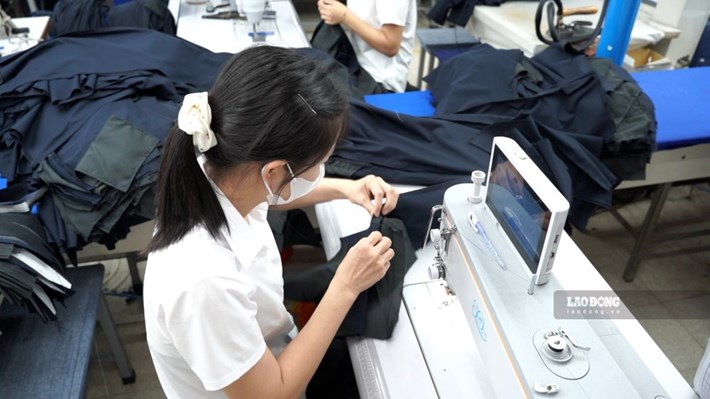
In the context of digital transformation, artificial intelligence and automation are changing production and business methods, and the requirements for workers' skills are increasing. Businesses not only need specialized human resources but also require the ability to apply technology, adapt to the digital working environment and proactively innovate working methods.
Sharing at the "Three-Party Link to Unlock Innovation" seminar organized by Lao Dong Newspaper, Mr. Vu Quang Thanh - Deputy Director of Hanoi Employment Service Center - said that through job counseling, introduction and labor supply-demand connection activities, the gap between the capacity of job seekers and recruitment requirements is clearly shown in many aspects.
First of all, the digital skills of a part of workers do not meet practical requirements. Many new candidates are proficient in basic office informatics, while businesses need personnel capable of using specialized software, work management platforms, data exploitation and artificial intelligence (AI) applications to improve productivity.
In addition, the innovative thinking and problem-solving capacity of workers are still uneven. A part of candidates still work passively according to instructions, not boldly proposing initiatives and process improvements to adapt to new technologies and production methods.
Communication skills, teamwork, time management, labor discipline and sense of responsibility are also factors that businesses pay special attention to, besides qualifications and professional certificates.

According to Mr. Thanh, the biggest gap today lies in the ability to transform knowledge and skills into practical work efficiency, along with the ability to self-study and adapt continuously.
Businesses not only find people who know technology but also need people who can use technology to improve labor productivity, quality and work efficiency" - Mr. Thanh emphasized.
From that reality, training needs to shift strongly from simply equipping knowledge to developing practical competence, digital competence and lifelong learning ability.
However, the training connection process between schools and businesses still has many barriers. Some training programs have not kept up with the pace of technological changes and recruitment needs. The participation of businesses in the training process is also uneven. On the contrary, some training institutions lack information about technology, processes and job standards at enterprises. In addition, labor market data is still fragmented and does not fully meet the requirements for forecasting human resource demand by industry, job position and specific skills.
On-demand training, linking learning outcomes with employment
To remove the above barriers, Mr. Vu Quang Thanh believes that it is necessary to shift from formal linkages to product-based cooperation and specific responsibilities between the State, schools and businesses.
In which, businesses need to participate in determining output standards, ordering training and receiving learners. Training institutions must flexibly update programs, increase practice time, and state management agencies need to improve support mechanisms and improve the quality of information and labor market forecasting.
Mr. Thanh proposed organizing flexible training programs according to short-term modules, combining direct and online learning, arranging appropriate study schedules or training right at the enterprise.
In particular, before organizing a course, it is necessary to survey human resource needs, unify skill standards, number of recruits and methods of post-training assessment. Through this, workers can see specific job opportunities, instead of participating in courses with unclear applicability.

From the experience of connecting the labor market, Mr. Thanh assessed that the highly feasible model is training according to business orders, associated with practice and practical projects.
The school is responsible for organizing training, updating programs according to business needs, increasing practice and evaluating results based on work performance capacity.
Meanwhile, the State plays the role of creating, coordinating, perfecting policies and supervising training quality. Employment service centers promote the role of collecting and analyzing data, forecasting recruitment needs and connecting businesses with training institutions.
Placed within the requirements of implementing Resolution 57-NQ/TW of the Politburo, Mr. Thanh emphasized that human resource training cannot only aim to meet an immediate job position but must form adaptive, creative and technological mastery capacity in the long term. This requires a shift from one-time learning thinking to lifelong learning, from basic computer skills to comprehensive digital capacity, including data exploitation, AI application and ensuring information security.
When training is linked to recruitment needs and specific output results, workers can quickly participate in the labor market, increase income; businesses have suitable human resources to develop production.
See the original here