

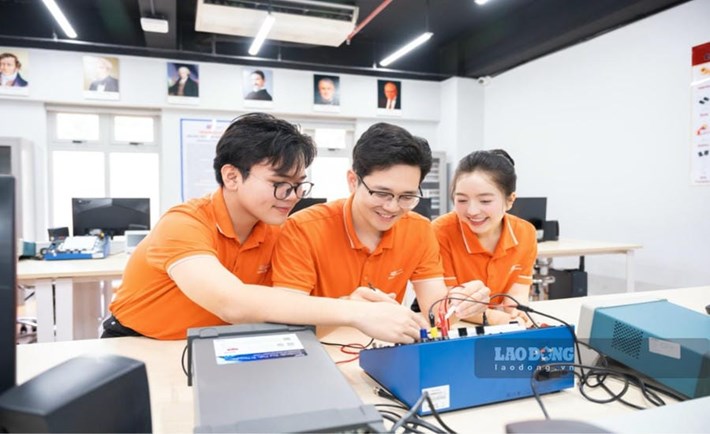
Students have wide doors to find jobs thanks to internships at businesses
Linking training with businesses helps students accumulate experience, improve practical skills and increase job opportunities even before graduation.
Job opportunities from the curriculum
Not having to wait until graduation, many students have had the opportunity to get acquainted with the real working environment right during their studies. For Dinh Quang Hung - a student at the Academy of Journalism and Propaganda - these experiences also open up opportunities to continue collaborating with the unit after practical time.
Hung said that his curriculum has practical and internship modules at agencies and companies related to his major. During an internship at a media unit, Hung was fortunate to be asked by the unit to continue collaborating after the internship ended.
Being able to continue collaborating helps me have more opportunities to work in the field, apply the knowledge I have learned and accumulate experience even when I was still in school" - Hung shared.
Linking training with practical experience at the business
In fact, many universities today are also strengthening the introduction of students to the business environment through internship programs, internships and study at businesses.
Talking to a reporter from Lao Dong Newspaper, Mr. Nguyen Tran Phuoc Bao - Head of Corporate Relations Department, FPT University - said: "On-the-job Training - OJT" is the main and compulsory module in the school's training program, creating conditions for students to study and experience at businesses.
The program is organized after students complete about 2/3 of the training process, with a duration of about 14 weeks. Students are coordinated by the school with companies to arrange internship positions, thereby having the opportunity to directly participate in the working environment instead of just approaching work through theory.
In this process, the school and the company jointly monitor, support and evaluate students. Assigned tasks, implementation processes and students' adaptability become the basis for evaluating the results of the semester.
Not only creating opportunities for students to experience the working environment, representatives of FPT University said that this process also helps the school receive direct feedback from companies.
These feedbacks are transferred to faculties, departments and lecturers for consideration and adjustment of training content. For issues reflected by many companies, the school can organize more thematic sessions to supplement the knowledge or skills that students lack" - Mr. Bao said.
Businesses see capacity through practical work
From the perspective of recruitment, Mr. Nguyen Duy Manh Cuong - Director of Hoai Thi Fashion Joint Stock Company - said that practical experience is a clear advantage for students when entering the labor market.
I assess this as a fairly clear advantage and encourage all students to do it" - Mr. Cuong shared.
According to Mr. Cuong, when a student has worked part-time, interned or participated in a real project, even if the job is not necessarily directly related to the major, that student has the opportunity to be exposed to the real working environment. Through this, students learn how to be punctual, coordinate with others, bear pressure and understand that working is different from studying.
I don't expect a new graduate to have the same experience as someone who has worked for a few years. But if the two candidates have equivalent abilities, I will prioritize those who have had practical encounters, because they usually catch up with the job faster" - Mr. Cuong shared.
According to him, instead of just focusing on making a beautiful job application, students should have "capacity evidence" through specific experiences.
When coordination between lecture halls and workplaces is maintained, the training process has an additional channel of feedback from reality.
Students are prepared earlier for the working environment, while requirements from the labor market have more basis to be reflected in training activities.
See the original here