

Online loan traps and the problem of safe credit access for workers
Only borrowing from a few million VND through an online application, borrowers must repay a large amount of interest after only 7 days. Not only borrowers, relatives and friends are also on the list of being threatened and pressured to repay debts.
Threatening to post images online because of acquaintance's debt
More than a month ago, Mr. Tran Minh (character name has been changed - PV) suddenly received a message from a strange number, providing personal information of an acquaintance and asking him to contact this person to pay the debt. If not, they threatened to post pictures of him and the borrower on social networks.
Although he did not respond and block strange phone numbers, Mr. Minh was still constantly harassed, at times almost daily. Debtors used vulgar language, threats, and continuously changed phone numbers to text and send images of borrowers with debt information.
I did not borrow money, did not stand out as a guarantor, and only met superficially with the person being demanded debt, but was still dragged into a matter that was not related to me. This makes me very annoyed and upset," Mr. Minh shared.
Not only being harassed by phone calls, Mr. Minh was also threatened with posting personal photos on social networks. "My job is to regularly contact customers by phone, so I am very troubled and worried that false information will affect my personal and family reputation," he said.
Finding acquaintances to ask clearly, Mr. Minh learned that this person had a sick child and needed money for treatment, so he registered to borrow 30 million VND through an online quick loan application.
People needed to borrow 30 million VND to treat their child's illness, but after completing the procedures, only 2.4 million VND was transferred to the account. And that 2.4 million VND, after exactly one week, 3 million VND had to be paid," Mr. Minh recounted.
Thus, in just 7 days, the loan of 2.4 million VND has generated an additional 600,000 VND, equivalent to 25% of the actual amount received. When realizing that the loan cost was too high, this person sought to borrow money from acquaintances to pay early, but the application did not accept it, requiring them to wait until 7 days.
I thought I would pay enough 3 million VND and it would be done, but the application automatically transferred 2.4 million VND to the account even though the borrower did not request it, and then continued to demand 3 million VND after a week. Wanting to terminate the loan was also unsuccessful," Mr. Minh recounted.
According to Mr. Minh, when registering to borrow, acquaintances provided both accounts and iCloud passwords according to the application's instructions. He suspected that the lender had taken advantage of this information to access contacts, take phone numbers of relatives and friends to threaten and put pressure on debt repayment.
Borrowing 1 million VND through an application, being asked for 3 million VND after 10 days
Mr. Nguyen Duong (character name has been changed - PV) recounted that relatives urgently needed money, so they went to a Facebook page advertising quick loans, without appraisal. After downloading the application, providing personal information and allowing access to the contacts, this person immediately received 1 million VND.
However, the loan was required to be repaid 1.7 million VND after 7 days, which means an additional 700,000 VND was incurred. From the 6th day, the application continuously called to remind of debt. When the borrower could not pay, the whole family was called to put pressure.
According to Mr. Duong, after only 3-4 days of overdue, the amount of money being demanded increased to 3 million VND, 3 times the initial loan, forcing his family to support debt repayment.
The above two cases show the risks from non-transparent lending applications: high interest and fees, risk of personal data leakage, causing both relatives and friends to be harassed and threatened with debt collection.
According to a report by the Criminal Police Department, Ministry of Public Security, in the period 2019-2025, the whole country has handled and resolved about 6,958 cases with 11,317 subjects related to black credit; prosecuted 4,297 criminal cases with 10,836 defendants. Usury activities are also distorted through social networks and phone applications, posing many risks for borrowers. Among them, workers and laborers account for a significant proportion.
Solving the problem of safe credit access for workers
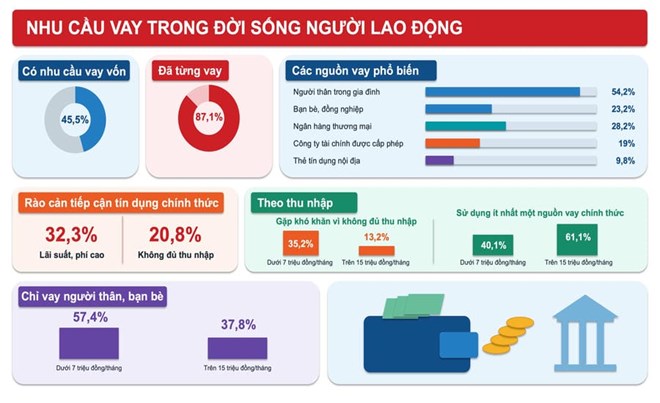
According to Dr. Nguyen Minh Phong - Member of the Economic Advisory Council, Vietnam Fatherland Front Central Committee, workers, especially low-income workers, often have a real need to borrow capital but find it difficult to meet the credit conditions of banks. The reasons stem from low or unstable income, lack of collateral, credit history and income proof documents. In particular, small and short-term loans to solve essential needs are not always conveniently met by credit institutions.

This gap puts a part of workers at risk of turning to unofficial forms of lending, application that is not transparent, and loans with high costs, posing a risk of debt.
In order to limit black credit, experts propose expanding preferential credit programs through the Vietnam Bank for Social Policies, trade unions and microfinance institutions. Commercial banks need to research small loan products, flexible terms, reasonable interest rates, suitable for the income cycle of employees.
At the same time, it is necessary to build a comprehensive financial security ecosystem, not only focusing on credit but also expanding savings, insurance and emergency support services.
Dr. Nguyen Minh Phong emphasized the coordinating role between the State, businesses, trade unions, banks and microfinance organizations. In which, businesses need to be transparent about income, creating conditions for workers to access credit and welfare programs. Trade unions can support job information confirmation, connect legal capital sources and monitor workers' rights.
Banks also need to study credit assessment methods based on cash flow and income history, instead of completely relying on collateral.
Promote financial education and protect workers in the digital environment. Guidance programs need to focus on how to calculate interest rates, identify borrowing costs, assess repayment ability and use safe digital banking services.
Along with that, it is necessary to strengthen the control of online lending activities, require public disclosure of interest rates, service fees and total amounts to be paid; strictly handle acts of usury, illegal debt collection and illegal collection of personal data.
See the original news here.

- Solutions to expand access to domestic credit cards for workers, pushing back black credit
- Trade unions in Ho Chi Minh City contribute to pushing back black credit
- Trade union shield in Dong Nai helps tens of thousands of workers stay away from black credit
- Workers borrow black credit, trade union officials are harassed by debt collectors