

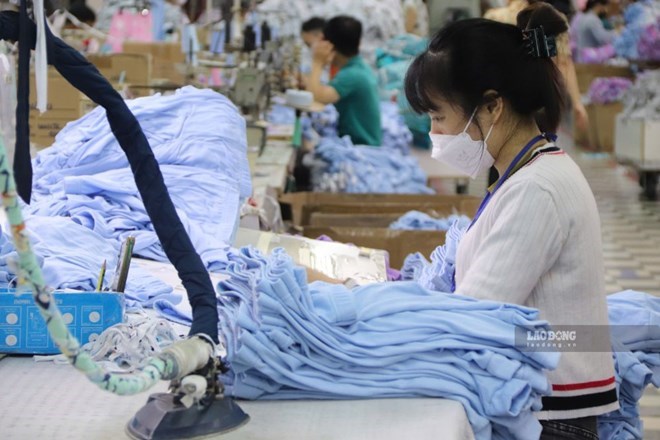
Trade union acts as a bridge to help workers access loans
Trade union organizations promote the role of connecting with banks, helping workers access loans safely and conveniently.
Talking to Lao Dong Newspaper, a representative of the Vietnam Bank Union said that with 200,000 union members working at the State Bank, banks and finance companies, the Vietnam Bank Union has a special advantage in acting as a bridge between capital needs holders and lenders.
According to representatives of the Vietnam Bank Union, industry trade unions have three main roles in promoting credit institutions to expand lending products suitable for workers and laborers.
First of all, it is policy recommendations, reflecting the needs of workers to the State Bank and the Vietnam General Confederation of Labor to improve the mechanism for consumer lending and small-limit domestic credit cards.
Second, through the grassroots trade union at each bank, the Vietnam Bank Union mobilizes credit institutions to design products with streamlined procedures, and appraise based on salary and insurance data instead of collateral.
Third is to supervise and protect borrowers, including proposing transparency in interest rates and fees; implement debt recovery in accordance with the law and prevent fraudulent acts disguised as preferential loan packages.
Regarding the development of credit products suitable for workers, at the Workshop "Solutions to expand access to domestic credit cards for workers, pushing back black credit" organized by Lao Dong Newspaper in coordination with the State Bank of Vietnam on November 19, Mr. Hoang Hai Vuong - Deputy General Director of Nam A Commercial Joint Stock Bank (Nam A Bank) - proposed many solutions from commercial banks.
According to Mr. Vuong, from the experience of deploying unsecured loan products for officials and employees and lending to small traders, the bank realizes the important role of intermediaries such as trade unions, schools or market management boards in the process of approaching customers.
This practice shows that it is not that workers or small traders lack credit needs or are not able to repay debts, but in many cases banks do not have approaches and assessments suitable to their specific characteristics.
For workers and laborers, Mr. Vuong believes that it is necessary to better exploit income data, salary history, working hours, business stability and current financial obligations to assess actual debt repayment capacity.
Representatives of Nam A Bank proposed the High-volume, high-tech method, combining group customer approach with similar characteristics to applying technology and data to design suitable products.
Accordingly, banks can classify employees by industry, business, industrial park, income level and form of salary payment. In the immediate future, it is advisable to select a number of large-scale businesses or industrial parks with relatively complete income data and paid salaries through banks for piloting before expanding.
Notably, Mr. Hoang Hai Vuong emphasized that banks should not take the maximum credit limit as a goal but must base it on the safe debt balance that employees can repay.
The determination of the limit needs to consider actual income, job stability, existing loans and essential living expenses. The limit can be adjusted to gradually increase according to the spending and debt repayment history; the payment cycle needs to be consistent with the payroll period, and interest rates and fees must be transparent and easy to understand.
To bring products to workers, representatives of Nam A Bank proposed strengthening coordination between banks, businesses, industrial park management boards, trade union organizations and wage-paying units.
Businesses can support communication, information verification and create conditions to access employees on a voluntary basis, ensuring privacy and consensus. Banks are responsible for investing in technology, completing appraisal processes, controlling credit quality and on-time payment capacity when expanding card issuance.
See the original here